
Instant coffee seems unremarkable. It’s just powder and hot water. But making it work took decades.
The convenience of instant coffee masks a surprisingly difficult problem. Coffee’s appeal lies in the hundreds of volatile compounds that create its flavor and aroma, exactly the substances most likely to disappear during processing. Creating instant coffee required developing techniques to extract the soluble molecules in coffee from the insoluble plant matter without destroying the fragile compounds that make coffee worth drinking.
The first attempt at the drink was, by all accounts, terrible. In 1771, over two centuries after coffee reached Europe, Londoner John Dring filed a patent for a ‘coffee compound’. Dring’s method involved mixing ground coffee with butter and tallow, then heating the mixture on an iron plate until it thickened into a paste that could be shaped into cakes. These cakes were then dissolved in hot water to make coffee. The purpose of the animal fats isn’t entirely clear. They may have been intended to extract and carry soluble compounds from the coffee grounds or to preserve the ground coffee from oxidation. Whatever Dring’s aim, the method wasn’t commercially viable because the fats went rancid, causing the cakes to spoil quickly.
Subscribe for $100 to receive six beautiful issues per year.
During the mid-1800s, several firms produced instant coffees as thick liquid concentrates that could be reconstituted with water. In 1840, the Scottish company T & H Smith developed a ‘coffee essence’ by brewing coffee and reducing it to around a quarter of its original volume. This thick liquid was mixed with chicory extract and burnt sugar syrup, creating a molasses-like concentrate. One or two teaspoons mixed with boiling water made a drink, though it tasted more like coffee flavored molasses than proper coffee.
Another attempt came during the American Civil War. In 1832, President Andrew Jackson had replaced soldiers’ daily spirit rations with coffee beans and sugar. This created a heavy logistical burden for the army, with a 20-day supply for 100,000 troops weighing 250 tons, all needing transport by horse-drawn wagon. Roasting, grinding, and brewing coffee in the field was also time-consuming for soldiers.
In 1861, the Union Army began investigating instant coffee as a solution. They procured a coffee concentrate from the firm HA Tilden & Co, consisting of a mixture of thickened coffee and sweetened, condensed milk. This halved the weight and size of the coffee, but was unpopular with soldiers, who compared its consistency to axle grease.
These essences were made by boiling down brewed coffee to concentrate it. This damages the flavor, producing a bitter, unpleasant drink, hence the old saying that ‘coffee boiled is coffee spoiled’. That’s why they were syrups. Boiling away all the water to create a dry powder would have destroyed whatever coffee flavor remained. To make a viable instant coffee powder, producers needed a way to remove the water from brewed coffee without boiling it.
A spice merchant’s solution
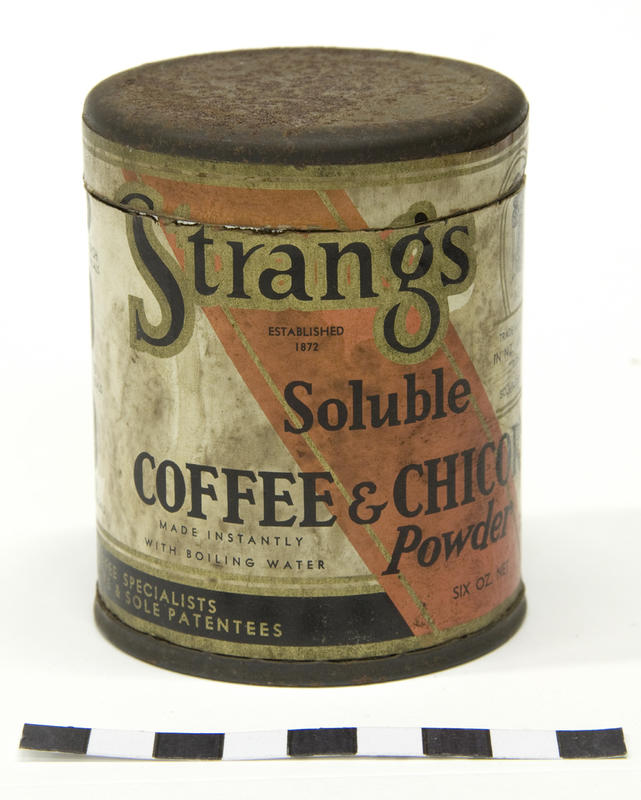
The first genuine instant coffee powder emerged in 1889, created by David Strang, a spice merchant in Invercargill, New Zealand. He developed a ‘Dry Hot-Air’ method that removed water from coffee by blowing heated air over it, likely using a spice dryer he’d patented a few years earlier. While hot air dehydration had been used in France since 1795 to dehydrate foods like pasta for commercial sale, Strang was the first to apply it to coffee.
The method works by warming the air around the coffee rather than the coffee itself. Turning water into vapor requires energy, which evaporating water draws from the heated air passing over it. Because this energy comes from the air rather than the liquid, the coffee surface actually gets cooler as it evaporates. This keeps the liquid below boiling temperature even as it dries.
As a dry powder, it was lighter and more shelf-stable than previous attempts at instant coffee, making it more practical for shipping and storage. The product achieved modest commercial success in New Zealand, being advertised as ‘Far superior to any so-called coffee essence’. But the taste was still far from ideal, coffee expert Arjun Haszard notes: ‘This process, given what we know about what happens to coffee with heat and air would have undoubtedly resulted in heat damaged, oxidized coffee. Portable, yes, but also most likely horrible’.
belied an almost undrinkable product.
George Washington goes to war
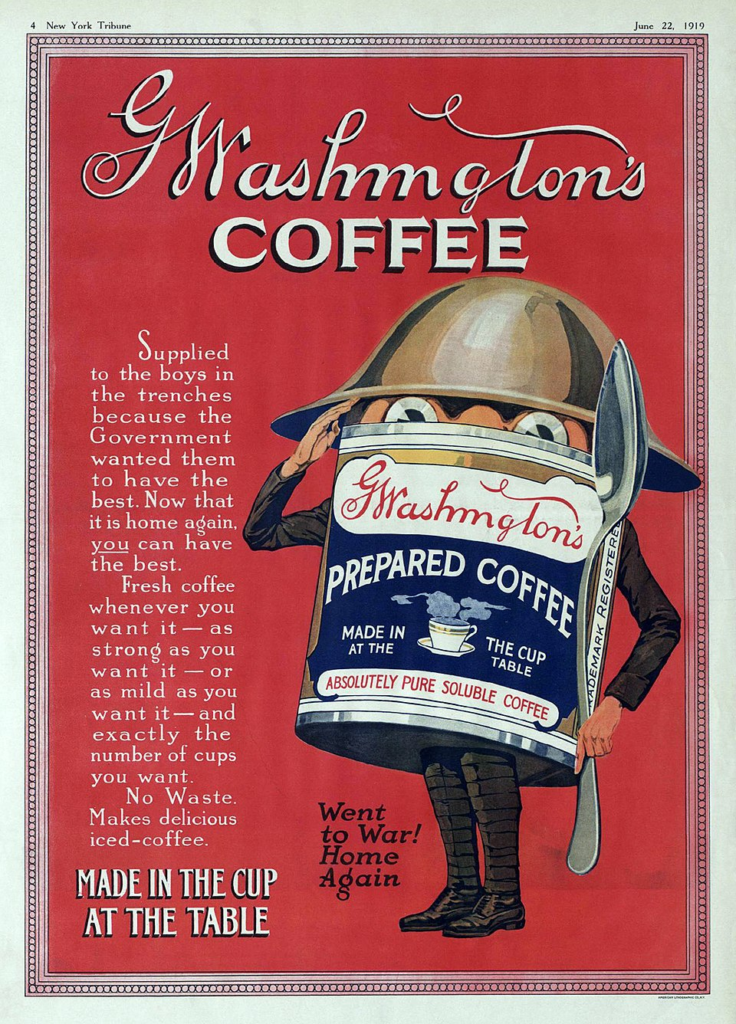
The first instant coffee to achieve widespread commercial success came in 1909 when Belgian-British inventor George Constant Louis Washington launched Red E Coffee. Washington kept his method a trade secret, so the exact process remains unknown, but the result wasn’t clearly superior to previous attempts, with the taste described as ‘disagreeable’. Washington’s success seems to have come mainly from being the first to build an industrial-scale production facility, located at Brooklyn’s Bush Terminal industrial complex.
The coffee was fairly popular in its first few years of production, but demand surged when World War I began. The military procured the entire available production, which peaked at 37,000 pounds (16.7 metric tons) per day. Despite the poor taste, the sheer convenience of instant coffee provided a significant morale boost to the troops. One soldier’s letter home captures this sentiment:
I am very happy despite the rats, the rain, the mud, the draughts, the roar of the cannon and the scream of shells. It takes only a minute to light my little oil heater and make some George Washington Coffee . . . Every night I offer up a special petition to the health and well-being of Mr. Washington.
By the end of the war, the American army was being called the best-fed on Earth. Instant coffee rations, no doubt, were an enviable luxury.
Solving the sticky problem
In 1929, the Wall Street Crash devastated Brazil’s economy. Brazil relied heavily on coffee exports, which made up half of its total exports, and the US was its biggest customer. Coffee prices collapsed 90 percent within a year, contributing to the 1930 revolution that overthrew the government. To stabilize prices, the Brazilian government burned 10.3 billion pounds (4.6 million metric tons) of coffee over multiple years. This was the equivalent of three years’ worth of global coffee production. A 1937 Time article described the scene: ‘huge grey-green piles of coffee beans smouldering slowly away under great smoke plumes, barges lumbering out to sea to dump coffee overboard, workmen mixing coffee and tar into briquets for building’.
During the crisis, Banque Française et Italienne pour l’Amérique du Sud, the French and Italian Bank for South America, found itself with a huge surplus of coffee in its warehouses. To find a use for the excess beans, they approached Nestlé chairman Louis Dapples, a former employee of the bank, with a proposal to develop a better instant coffee product. Swiss chemist Max Morgenthaler was put in charge of the project in 1932, but with no signs of success, Nestlé cut funding for it in 1935. Undeterred, Morgenthaler purchased his own coffee beans and continued his research from home, occasionally using equipment from the factory laboratory during quiet periods. In April 1937, he achieved a breakthrough and presented samples to Nestlé’s executive board. They were well received. One attendee exclaimed, ‘Mother Nestlé has produced a beautiful baby!’
Morgenthaler’s process involved passing hot water through multiple columns of ground coffee to create a coffee extract, which was then spray dried. Spray drying is a technique invented by chemist Samuel Percy in 1872 for converting liquid into powder. It works by spraying liquid as a fine mist into a heated chamber, where hot air rapidly evaporates the water, turning the droplets into powder.
Spray drying had been successfully used to make milk powder since the early 1900s, but applying it to coffee presented unique challenges. Coffee’s natural sugars and acids have low molecular weights, meaning they soften and become sticky at relatively low temperatures. During spray drying, this causes the coffee to clump together into a paste rather than forming a free-flowing powder. Morgenthaler’s solution was to mix the coffee with roughly equal parts carbohydrates like maltodextrin or glucose before drying. These larger carbohydrate molecules remain solid at higher temperatures, raising the point at which the mixture becomes sticky and allowing it to dry into proper powder particles.
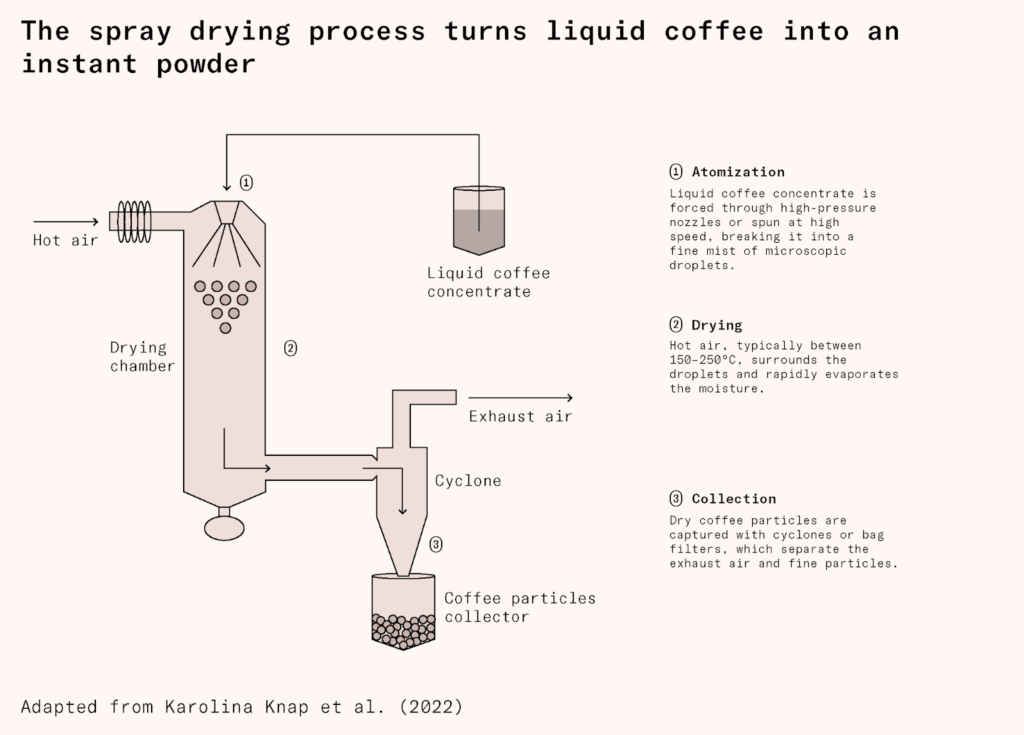
Despite using much higher air temperatures than previous methods (typically 150–250 degrees centigrade), spray drying actually causes less heat damage to the coffee as the droplets spend only seconds in the heated chamber, and the evaporating water keeps them relatively cool.
The product was launched in 1938 as Nescafé. It was an instant hit, and a year’s worth of stock sold out in two months. World War II boosted sales massively. In 1942, demand from the US military was so great that the government classified it as a ‘commodity vital to the war effort’, with the entire output of Nestlé’s US plant dedicated to supplying the armed forces.
From ice to vapor
While Morgenthaler solved the technical problem of spray drying coffee, the added carbohydrates diluted the coffee flavor significantly. Nestlé resolved this in 1952 by discovering they could extract natural carbohydrates from the coffee itself. The method worked by first passing water through ground coffee at very high temperatures (up to 175 degrees centigrade) under pressure, breaking down cell walls and releasing carbohydrates called polysaccharides that don’t dissolve at normal brewing temperatures. The liquid then flows through additional columns at around 100 degrees centigrade to extract flavor compounds, as in the original method. The result was 100 percent pure coffee powder.
Spray drying kept heat exposure brief, but manufacturers wondered if they could avoid high temperatures altogether using a process called freeze drying. The method involves freezing materials, then placing them under low pressure, turning the ice into vapor without passing through a liquid phase. This happens because at very low pressures, water can exist only as solid ice or as vapor, not as liquid, so gentle warming turns the ice straight into vapor, a process called sublimation.
Various cultures had practiced forms of freeze drying for centuries – the Inca freeze dried potatoes in the high Andes in the thirteenth century – but industrial interest grew during World War II when trying to find a way to preserve blood plasma and penicillin. Without reliable refrigeration, these supplies often spoiled before reaching patients. Freeze drying removed the water content, allowing them to be stored at room temperature and quickly reconstituted when needed.
In 1963, Maxwell House, a coffee brand owned by General Foods (and now part of Kraft Heinz) released the first freeze-dried instant coffee. Nestlé followed in 1965 with Nescafé Gold. The process involves freezing coffee extract to between minus 40 and minus 45 degrees centigrade, and then breaking the frozen slabs into granules and sieving them to size. These granules are placed in vacuum chambers where controlled heat causes the ice to sublimate over several hours, leaving dry coffee powder.
Freeze drying retains flavor much better than spray drying. One study found that freeze drying maintained 77 percent of volatile compounds compared with 57 percent for spray drying.
Another advantage is texture. Freeze drying produces coarse, porous granules that dissolve quickly and completely in hot water. Spray drying, by contrast, produces fine powder particles that tend to float on the surface rather than dissolve. To address this, manufacturers now often add an agglomeration step where spray-dried powder is exposed to steam as it tumbles in the air. The moisture causes particles to stick together and form larger granules.
Freeze drying has drawbacks. The process takes 8–16 hours and requires expensive vacuum equipment and condensers. Freeze-dried coffee typically retails for roughly twice as much as spray dried coffee, which is why spray drying remains the dominant method.
Premium instant
Instant coffee has spent most of its history as the cheapest, quickest, and most portable coffee, but with a reputation for low quality when it comes to the flavors that coffee lovers seek out. That has begun to change: a market for premium instant coffee has opened up over the past two decades. Today, specialty roasters like Verve and Supreme offer freeze-dried versions of their coffees, often selling for around $2.50 per cup, 35 times the price of standard instant.
Making this possible required technical breakthroughs. One issue was aroma loss. While freeze drying helped preserve more volatile compounds during drying, delicate aromatics could still be lost during earlier stages like roasting, grinding, and extraction. Retaining more of these compounds required improved aroma recovery methods that capture volatiles early in the process, store them separately, and add them back after drying. Primitive forms of aroma recovery had existed since the early twentiethtwentieth century, but advances since the arrival of freeze drying gave manufacturers better tools to preserve the subtle characteristics that distinguish specialty beans.
Flavourtech’s spinning cone column, originally developed for dealcoholizing wine, has become a popular aroma recovery technology in premium instant coffee production. The device consists of a vertical cylinder containing alternating fixed and rotating cones stacked like ice cream cones. A slurry of ground coffee and cold water poured in at the top cascades down, with each rotating cone flinging the liquid outward into a film roughly a millimeter thick. Low-temperature steam (40–50 degrees centigrade) rises through the column, collecting volatile aromatics from the coffee before cooling and condensing into concentrated aroma extract. The process is quick: coffee spends only 25 seconds in the machine.
Even with gentler methods, flavor compounds are inevitably lost during the drying process. Flash-frozen coffee avoids this by skipping dehydration entirely. Flash freezing is an existing technique, but was adapted to coffee by Massachusetts-based company Cometeer, founded in 2016. It involves brewing coffee at ten times normal strength, then exposing it to cryogenic temperatures using liquid nitrogen. At this extreme cold, the coffee freezes almost instantly, fast enough that ice crystals remain small and don’t damage the coffee’s structure or degrade volatile compounds. The frozen concentrate is then sealed in aluminum capsules.
Flash freezing isn’t cheap. It requires expensive cryogenic equipment and frozen distribution infrastructure, because products must be packed in dry ice and delivered quickly to avoid thawing on the way to the end consumer’s freezer. As a result, Cometeer’s capsules start at around $2 per cup, with prices reaching $7.50 for the most premium beans.
Texture and mouthfeel presented another opportunity for improvement. Fresh-brewed coffee contains oils that coat the tongue and fine particles that create body. The water extraction process used to make instant coffee leaves these behind. Because they don’t dissolve in water, they can’t be captured in the soluble powder. Without them, instant coffee tastes thinner.
Microgrounds offered a way to address this. In September 2009, Starbucks launched VIA Ready Brew, a product that had been in development for nearly 20 years under Don Valencia, the founder of Starbucks’ R&D division. The innovation combined soluble instant coffee with roasted coffee particles small enough to suspend in water rather than fully dissolve. Competitors quickly developed their own microground offerings, with Jacobs Douwe Egberts (now JDE Peet’s) launching Millicano in 2011 and Nestlé launching Nescafé Azera in 2012. However, this hasn’t been universally adopted in premium instant coffee. One issue is that the microgrounds leave a layer of sediment at the bottom of the cup.
Technology alone wasn’t enough to create a premium instant market. The economics of production also had to change. Instant coffee production requires multi-million dollar capital investments in extraction batteries, concentration equipment, and drying facilities. Historically, only manufacturers running at massive scale could justify these costs, leaving specialty roasters with no realistic path into the category.
This changed in 2016 when Nate Kaiser founded Swift Cup Coffee in Lancaster, Pennsylvania, pioneering what you might call instant coffee as a service. Today, a vibrant market of contract processors exists to serve specialty roasters. These processors brew roasters’ beans to precise extraction standards, freeze dry in small batches, and package the finished product under the roaster’s own brand. This converts lumpy fixed costs into variable costs, letting roasters test the market without major investment.
While instant may never be the coffee connoisseur’s preferred drink, decades of innovation have earned it a role in millions of people’s lives. From troops in the field to rushed mornings and camping trips, it offers a practical solution when time or equipment are scarce.