
Not all NIMBYs are alike. Dividing the most unreasonable ones from the rest might be the key to getting homes built.
In many affluent countries, existing land use regulations constrain the housing supply. Zoning directly restricts what can be built in a neighborhood or ‘zone’. To circumvent zoning rules, developers seek variances that require complex, multistage, and lengthy approval processes. Design rules, environmental assessments, and labor requirements further increase construction costs, decreasing what can be built. Cumulatively, these restrictions drive up housing prices and generate extraordinary social and economic costs.
The high costs of land use restrictions have led many groups to campaign for reform. Since these regulations are usually set by local governments, reformers have targeted higher levels of government (like state governments in the United States and the national government in Britain) to circumvent local land use restrictions. This is the preemption strategy, by which higher levels of government override (or preempt) land use restrictions set by lower levels of government.
Subscribe for $100 to receive six beautiful issues per year.
The preemption strategy has produced important successes. California has seen a boom in accessory dwelling units (ADUs) after restrictions were relaxed beginning in 2016. Just recently, following a decade-long effort, housing reformers achieved a significant milestone when California passed Senate Bill (SB) 79 to upzone areas around transit stops in major metropolitan areas. Similar legislative victories have occurred elsewhere in the US and other countries.
Yet challenges remain even after legislation is passed. Entrenched interests defending land use restrictions are often able to mobilize against housing development by delaying implementation at the local level, launching court challenges, and even reversing reforms. While the effects of the most recent reforms are uncertain, past examples indicate that preemption proposals are just as likely to provoke resistance and retrenchment as they are to succeed at expanding the housing supply.
This record invites us to consider more radical models of land use reform. In recent years, a variety of communities have had striking success with increasing housing through direct democracy. The preemption strategy presumes that local residents must be forced to accept more housing development, which they invariably resist. But when given the choice, neighborhoods across different contexts have directly approved the construction of new housing through referendums.
Due to its political durability, empowering local residents holds a key advantage over preemption. As all reformers agree, there are enormous benefits to building new homes. Mechanisms for direct democracy at the very local level assure existing residents that they can share in these benefits. When shared, these benefits provide majorities of local residents a reason to override the objections of extreme opponents of development and allow many more homes in their own communities.
With a broad coalition organized around sharing the massive material benefits of new housing, reformers can overcome persistent political barriers and transform land use around the world.
The limits of preemption
As many as one in ten American households lives in a home that costs more than twice as much to buy as it would to build. On the California coast, median home prices are roughly three times construction costs. The situation is similar in other economic centers internationally, including London, Paris, Sydney, and Toronto.
In most markets, supply would rise to meet demand. But in the case of housing, land use regulations effectively cap supply, increasing prices. Empirical evidence bears this out: greater land use restrictions are associated with less housing and higher prices.
The predominant strategy to alleviate the housing shortage is to preempt local land use regulations. This strategy is based on a theory of incentives facing different levels of government. By this view, local residents experience real costs of development, including construction noise, traffic congestion, and pressure on local services. But the benefits of new housing are enjoyed by future residents or diffused across the wider economy. This disjuncture between the costs and benefits of development at different geographic scales provides local governments a reason to oppose development, even when the overall social benefits far outweigh the local costs. Consistent with this, more local representation appears to reduce housing construction.
Following this logic, reformers have sought to transfer decision making over land use to higher levels of government. At wider geographic scales, most voters benefit from the positive economic impact of new housing but experience no cost, so they would seem to have an incentive to support land use regulations that facilitate development. Housing reformers have therefore encouraged higher levels of government to preempt local zoning rules.
Promising reforms . . . alongside disappointment
The core critique of existing land use policy is correct: regulatory barriers to new housing and associated obstruction by Not In My Back Yard (NIMBY) neighbors together inhibit housing development. With too little housing being built in recent decades, prices have spiked. Policies like subsidizing homebuyers or prohibiting large institutional investors from owning single-family homes do not change this basic fact. And by attacking the core problem – land use restrictions on development – reformers have produced important results through preemption.
In New Zealand, after the center-left Labour Party attained power following the 2017 election, the new government built on earlier reforms by abolishing parking requirements and requiring all major local councils to allow housing development up to six storeys near transit stops, commercial centers, and city centers. The Labour government even collaborated with the conservative opposition National Party on a subsequent reform to effectively upzone the entire country to allow three-storey townhouses on every lot. Parliament enacted this policy, the Medium Density Residential Standards, in 2021.
In 2023, Montana enacted an extensive range of zoning reforms. The ‘Montana miracle’ eliminated single-family zoning in cities with over 5,000 residents, required cities to allow ADUs on plots with single-family homes, and restricted local discretion in setting building codes. Additional legislation in 2025 allowed taller buildings, capped impact fees on developers, and curtailed parking requirements, among other reforms.
California has also seen notable successes. In 2021, SB 9 reduced local discretion over approvals for subdividing or building duplexes on existing lots, and in 2025, reforms to the California Environmental Quality Act (CEQA) created exemptions to promote multifamily infill development. In October, California’s governor signed SB 79, preempting local governments by upzoning land near rail stations and rapid bus lines in eight (soon to be nine) of the state’s 58 counties.
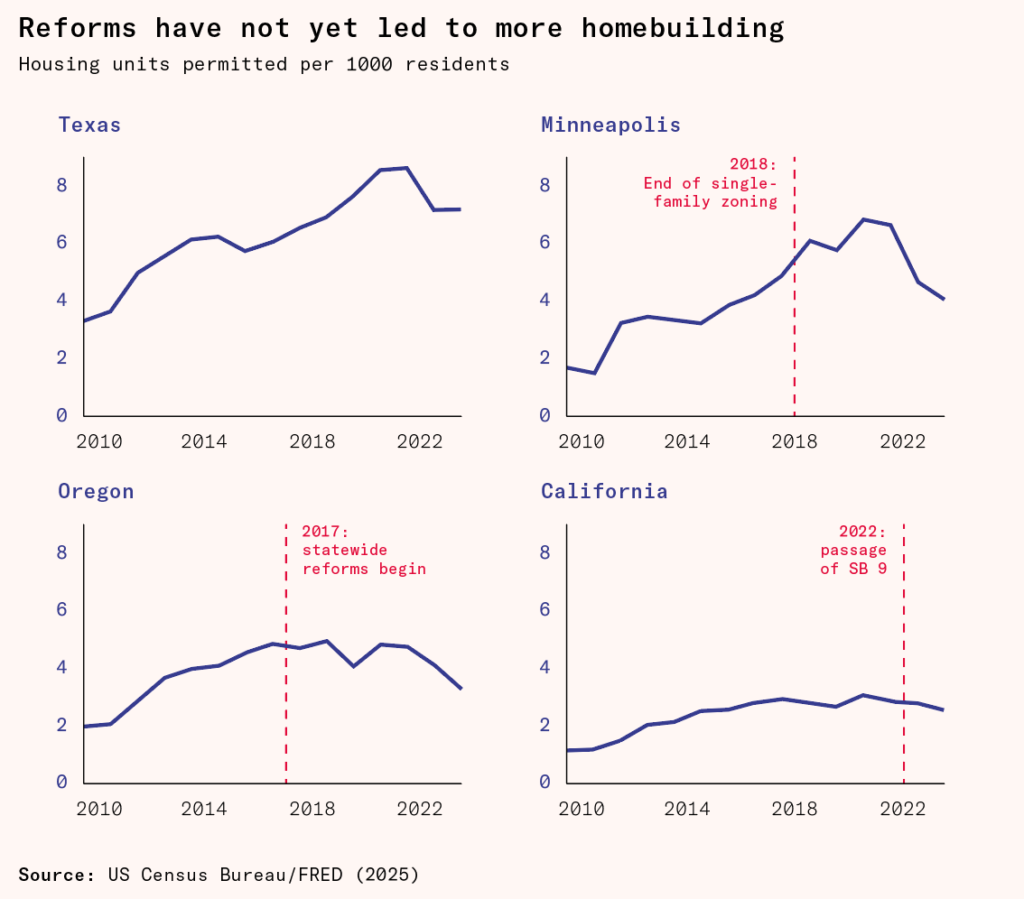
These laws exhibit real success, but they also lay bare the limits of preemption. In many cases, dramatic reforms have yet to show a positive effect on housing construction. This is plausibly because many have been, by political necessity, surgically targeted at specific areas like transit stops, while reforms with potentially wider impacts face backlash and retrenchment. Despite aiming to eliminate opportunities for obstruction, land use reforms have often left NIMBY opponents more motivated than ever to block new housing.
After passing New Zealand’s Parliament, the Medium Density Residential Standards generated widespread backlash. Local councils slow-walked implementation, and the National Party reversed its support after its usual minor-party ally, ACT, attacked them for backing the reforms and the ACT leader began beating National’s leader in polls. National then withdrew its support for the Medium Density Residential Standards and defeated Labour in the 2023 election. The bipartisan consensus favoring reform managed to bring New Zealand’s housing production up to the level of Australia’s but collapsed in the face of public opposition.

In the case of Montana, an effect on housing supply and prices is not yet evident. A lawsuit by a homeowners’ group delayed implementation. The reforms survived, but the vehement opposition raises the possibility of future erosion should the political context change. Montana has a distinct mix of cost-burdened longtime residents and wealthy newcomers from high-cost states. This political dynamic could yield increased opposition in the future, and Montana’s unique housing politics may not provide political lessons for other places.
Like Montana, California has yet to see an aggregate increase in housing construction, but this follows ten years in which over a hundred pro-housing laws have been passed. Due to carveouts, loopholes, and ‘strenuous opposition by local governments’, these bills have had ‘limited to no impact on the state’s housing supply to date’, according to the pro-housing group YIMBY Law (YIMBY stands for ‘Yes in My Back Yard’). Following SB 9’s enactment, UC Berkeley’s Terner Center found that the law has barely been used. Disconcertingly, building permits issued for new private housing units in California show little change since 2015: still hovering around 9,000 per month in a state of nearly 40 million people. By comparison, Texas, with a smaller population, issued roughly 17,000 permits per month during the same period. Perhaps SB 79 and the recent CEQA rollback will succeed where prior laws failed, but both are incremental reforms involving important compromises, and California has a lot of ground to make up.
These examples are only a sample of notable cases. A series of ambitious reforms in Oregon since 2017 appears to have had no impact so far on overall housing production, as is also true following the 2018 elimination of single-family zoning in Minneapolis, Minnesota. Across the US, land use reforms have faced homeowner lawsuits and court injunctions. In Australia, New South Wales Premier Chris Minns swiftly backtracked from a ‘sweeping’ 2024 plan for transit-oriented development in response to opposition from localities and the Australian Greens party. In the United Kingdom, Boris Johnson’s government backed down from a ‘radical’ 2020 proposal to, among other things, establish a presumption in favor of development in defined areas across the country. The backlash was so intense that land use rules ended up stricter than before.
The political problem
Preemption faces three intertwined problems. First, the opponents of development are still represented at higher levels of government, meaning that land use reforms inevitably involve compromises and concessions to these opponents. Second, these compromises enable extreme opponents of development to wield their continued capacity for obstruction, imposing high costs on developers. Third, these high costs make it impossible for developers to compensate the broad majority of residents for the downsides of development near them. The result is public opposition to development and prohibitively high costs for developers.
Though proponents of preemption seek to circumvent local opponents of new housing, local preferences are reflected within higher levels of government. Policies to expand the housing supply often depend on support from representatives of affluent, homeowner dominated, and politically powerful regions, such as Marin County, California. The YIMBY Act, first introduced in Congress in 2019, generated optimism among advocates of preemption, but the key senator behind the bill notably emphasized that it does not impinge on local decision making.
In the US, strong traditions of federalism, localism, and separation of powers provide myriad opportunities for opponents to halt even those reforms with majority support. In California, legislative leaders have blocked pro-housing bills, and the same occurred with Governor Kathy Hochul’s proposed reforms in New York. Elsewhere, governors in Connecticut and Arizona vetoed legislation to liberalize zoning rules. Opponents of development may be weaker at higher levels of government, but they are far from powerless.
As a result of this political obstacle course, land use reforms are often watered down, leaving room for opponents to regroup and continue fighting. For instance, after the New Jersey Supreme Court compelled municipalities to provide for their ‘fair share’ of housing, lawsuits and political deadlock eventually led to the dissolution of the state body charged with enforcement. Other reforms seek to avoid this fate through narrow targeting, such as SB 79, which applies to fewer than one percent of California’s transit stops, or additional compromises that undermine effectiveness.
Despite aiming to preempt local opposition, these reforms usually leave many opportunities for committed project opponents to obstruct and delay project approval. Often, all it takes is a single aggrieved neighbor to threaten a lawsuit or object at a zoning board meeting to delay a proposal, force the developer to alter it, or block it entirely.
As a result, developers can spend millions of dollars per project navigating the approval process. According to one estimate of housing development costs in New York City, a two-year review process can, on its own, add $58,000 per unit for a low-rise 40-unit project, meaning a $2.3 million increase for the whole project.
Furthermore, many development restrictions simply allow interest groups to extract value for themselves, regardless of the preferences of local residents. The resulting morass of regulatory requirements, including design codes, labor standards, and environmental protections, can dramatically increase the expense of building housing and infrastructure. For example, in the San Francisco Bay Area, it costs an estimated $531 per net rentable square foot to build market-rate housing and over $700 for affordable projects, which have even stricter rules. At $531, a modest home of 1,500 square feet costs around $800,000. At $700, even a tiny apartment of 150 square feet, smaller than a standard parking space, costs over $100,000.
Political pressure also compels developers to spend astonishing amounts on environmental preservation when that money would almost certainly do more for the environment elsewhere. For example, Britain’s High Speed 2 railway project is spending £120 million on a tunnel to protect three hundred bats. In California, a court recently awarded opponents of eight proposed apartment units $1.2 million in their lawsuit demanding further environmental review.
These high costs diminish the economic benefits that developers can share with local residents without giving residents a reason to support development. Developers often attempt to increase public support for project proposals by dividing some of the profits from development with nearby residents, typically in the form of local public goods such as parks or infrastructure improvements. But this source of benefits for residents is lost when developers spend huge sums navigating project approval processes and meeting complex regulatory requirements.
To be sure, some residents are immovable. There is the Berkeley ‘zucchini lady’, who brought a zucchini to a public meeting to dramatize what the shadows from a small development next door would destroy. And there is the person who sent 24,000 noise complaints to a single airport in just one year. But despite outsized media and political attention, the hardcore opponents of development are far from representative. A much larger group of moderately skeptical residents experience some downsides from nearby development but weigh both costs and benefits of project proposals. In surveys, most individuals appear to have imprecise views about housing policy, and multiple polls even show a surprising openness among respondents to new housing. At the same time, many people are acutely sensitive to conditions in their own neighborhood.
When local residents are asked to accept the costs of development without sharing in any of the benefits, it is unsurprising that they express opposition. Development provides a large surplus in principle. Yet after accounting for the costs of project approval, labor requirements, design codes, and environmental standards, as well as reduced profits due to affordability mandates, developers have little left to share with residents. This is a bargaining failure: both developers and a majority of local residents could be better off, but land use procedures eliminate the benefits that could be shared.
Not being compensated for local costs, these residents not only oppose specific project proposals, but also broader reforms to increase development. The opposition of moderately skeptical residents necessitates compromises in pro-housing reforms that hardcore opponents of development – who otherwise would not have much political influence – can then exploit.
How to solve the bargaining failure
Conceptualizing local opposition to new housing as a bargaining failure implies an alternative strategy for land use reform. By simplifying regulatory procedures and empowering majorities of local residents to directly approve development, reformers can enable bargains between residents and developers that increase development approval as well as overall public support for pro-housing land use policies. Preemption seeks to steamroll local residents; facilitating bargains brings them into a broad coalition supporting new housing. This alternative approach holds the potential to transform housing politics.
The bargaining-failure theory of NIMBYism is an application of the Coase theorem. Proposed in Ronald Coase’s 1960 paper ‘The Problem of Social Cost’, the Coase theorem holds that when property rights are clear and there are no transaction costs in bargaining, the allocation of property rights does not affect economic efficiency. If one party has the right to engage in an inefficient behavior, like blocking new housing, then the other can offer compensation to induce them to stop. But bargaining is prone to fail when transaction costs are too high or property rights are unclear.
Local opposition to housing development happens because the assumptions of the Coase theorem fail to hold. In land use policy, zoning operates as a kind of de facto and dysfunctional property right, and existing procedures involve high transaction costs.
In response to this bargaining failure, the preemption strategy seeks to transfer rights over development from local communities to higher levels of government. But this provokes opposition from local residents, who understandably resist having their rights taken away. This makes pro-housing reforms less likely to pass, while watering down the reforms that are actually enacted.
The Coasean solution is to grant a clear property right over development to local residents and minimize transaction costs within land use regulation. With a clear right over development, local residents can guarantee that developers provide benefits matching local preferences without these benefits being wasted in vain attempts to placate hardcore opponents. By enabling local residents to benefit from development, this strategy can transform moderate skeptics into reliable supporters of new housing. Hardcore opponents will no doubt remain, but as a small minority unable to impose their preferences on the majority.
Many reformers may be skeptical that local residents can ever be persuaded to support housing development. Yet numerous examples from around the world demonstrate that local residents often embrace development when they benefit from it. NIMBY preferences are not hardwired; people respond to incentives. And when institutions change, attitudes follow.
Empirical evidence
Israel has two programs to increase the density and safety of its housing stock: Pinui Binui (‘evacuate and rebuild’) and TAMA 38. Established in 1999 and 2005, respectively, both programs revolve around bargaining between existing homeowners and developers. TAMA 38 has been especially fruitful, allowing developers to bypass the typical zoning process if a supermajority of property owners accepts the developer’s proposal. Upon approval, the developer obtains the right to replace the old building with a new, larger one; existing residents receive a new home, and the developer profits from the sale of additional units. In Tel Aviv, these two programs are together responsible for over half of new housing.
The economic incentives created by these programs have transformed the politics of land use in Tel Aviv. Residents of upscale neighborhoods are known to object to local plans that have inadequate upzoning rights. Upon the scheduled expiration of TAMA 38, Tel Aviv’s replacement TA/5555 plan is expected to increase the maximum scale of redeveloped buildings by double or even quadruple what was previously allowed.
In Britain, ‘estate regeneration’ is used to redevelop public housing estates, which were mostly built in the decades following the Second World War and at low or medium densities. Under this process, developers replace existing homes with higher quality housing, while adding market-rate units. Because the land can be extremely valuable, the profits generated by the market-rate units go toward the costs of replacing and adding public housing units.
In 2018, London introduced a requirement that estate regeneration proposals obtain resident approval in order to receive city funding. The result? Regeneration proposals have achieved overwhelming support among residents. Of the 21 ballots held between their introduction and 2022, all but one were in favor. The average level of support for regeneration was 80 percent, with an average turnout of 72 percent. At least ten more have been held, and approved, since 2022. In many cases, the redeveloped estates have added hundreds of units along with local amenities such as parks, community centers, or gyms.
A related procedure, known as land readjustment, has had a major impact on urban development in Japan, South Korea, and Taiwan. Since 1919, Japan has allowed developers to negotiate with groups of adjacent property owners to redevelop their land by redrawing plot boundaries to enable the construction of roads, railways, parks, and much larger buildings. Under current policy, approval by two thirds of landowners allows the plan to proceed. An estimated 30 percent of urban land in Japan has been redeveloped in this way. In South Korea, roughly 40 percent of urban residential areas have utilized a similar program, as have over 17,000 hectares of Taiwanese cities.
Evacuate and rebuild, estate regeneration, and land readjustment – each based on a principle of negotiation, profit-sharing, and resident approval – have an analog in the US. Land use referendums in California force interest groups and developers to keep their eyes on voter preferences when negotiating over economic benefits. In many cases, these referendums are successful and new housing is built. Unfortunately, the length and complexity of existing approval processes, to which referendums are an added step, reduce the potential profits that developers can share with residents, eliminating the possibility of mutually beneficial agreements. When development referendums work in the US, it is often for very large developments with enough profit remaining after the planning process to share with local residents.
Although existing residents may be skeptical of development, they are responsive to both costs and benefits. With institutions to facilitate bargaining while granting local residents approval power over development decisions, residents can ensure they share in the benefits of development. When a majority of local residents benefit from new housing, they have reason to support policies that enable more housing.
Turning NIMBYs into YIMBYs
Implicitly or explicitly, housing reformers often treat local opposition to development as inevitable. This view leads many reformers to focus on preempting local land use regulations. Yet pro-housing reforms face many of the same barriers at higher levels of government that they do locally. As a result, these reforms have been constrained to small areas, defeated, or riddled with carveouts that render them ineffective. The bargaining framework offers a different path forward.
What kinds of institutions would best facilitate Coasean bargains between developers and local residents? Advocates of this strategy have suggested a couple of alternatives.
One option is street votes, which would allow residents of a single street or block to vote to upzone that area. This could involve allowing ADUs, duplexes or triplexes, or taller buildings. Advocates emphasize that implementing street votes does not necessitate a transformation of the land use process; it simply provides local residents an opt-in mechanism to upzone. Politically, the strategy is similar to that of upzoning in Houston, in which some areas were allowed to opt out.


Another option is neighborhood approval, an old idea that merits renewed consideration. Under this model, elected neighborhood representatives negotiate with developers and then residents ratify the agreement, analogous to a union contract. Following a neighborhood vote accepting the development proposal, there are no further approval stages, effectively granting the developer an instant zoning variance and incentivizing it to offer an attractive proposal to residents.
For resident-developer bargaining to succeed, the size of the decision-making unit needs to balance two factors: it must be large enough to cover the most important externalities, such as traffic and shadows, and small enough that a share in the development’s economic benefits makes a noticeable impact for individual residents. Many US cities already have neighborhood-level institutions as part of the planning process: empowering these to approve development could transform them from yet another veto point into a channel for more housing. A benefit of using existing institutions is that doing so allows reformers to avoid tricky questions such as where to set neighborhood boundaries.
To work best, such institutions will likely involve tinkering. For instance, Israel has reduced the threshold for resident approval from 80 percent to two thirds; the government also provides organizational resources to assist residents in negotiating with developers. The localism of this strategy facilitates experimentation and incremental adjustments to discover the most effective solutions.
The preemption strategy has achieved some crucial successes and activated a large movement in favor of housing reform, but the next stage requires more ambition. Majorities of local residents can and will support new housing if they share in the benefits of development. By embracing local democracy, housing reformers can turn entrenched opponents into powerful allies and, with a broad and durable coalition, build more housing.