
The technology to eradicate mosquito-borne disease already exists. We just have to be brave enough to use it.
Most Americans think of mosquito-borne diseases such as malaria, yellow fever, and dengue as problems that affect people in other countries, not their own. Until recently, they would have been largely correct: malaria and yellow fever were eliminated in the United States in the twentieth century, and dengue had become extremely rare, with most cases brought back from abroad. But as temperatures have risen and mosquitoes have developed resistance to pesticides, these diseases have become a growing problem again in the United States.
In 2024, the country reported almost 4,000 cases of dengue, a 360 percent increase over the average of 830 per year over the previous decade; Florida, California, and Texas all saw locally acquired transmission; and Puerto Rico declared dengue a public health emergency. Ten locally acquired malaria cases were reported nationwide in 2023, the first reported in twenty years. And though yellow fever remains gone for now, the mosquitoes capable of spreading it are still present.
But we don’t have to accept this threat. We have new ways to wipe out mosquito-borne diseases with minimal environmental cost. The United States is sufficiently well-resourced, and its disease-carrying mosquito population sufficiently small, that it can stamp out this problem entirely within its own borders.
The reason we haven’t is that the technology has spent fifteen years in regulatory limbo. Ending this impasse would allow us to eliminate many mosquito-borne diseases from the United States, and eventually the rest of the world.
The lethal gene
Genetic engineering can suppress mosquitoes: researchers insert a gene into male mosquitoes that means their offspring will not survive, and then release them into the wild, where they mate with females, prevent those females having any surviving offspring, and collapse local populations. In 2000, biologists at the University of Oxford demonstrated that this idea could work in fruit flies. They engineered the flies to carry a gene that makes a protein called tTAV, harmless in small amounts but lethal when it builds up. In the lab, the insects are reared in a medium laced with the antibiotic tetracycline, which keeps the gene switched off. But, in the wild, where there is no tetracycline, the gene switches on, and the offspring die before adulthood.
The scientists then formed a company, Oxitec, which was intended to work with governments to research and deploy the technology. They engineered the same gene into male Aedes aegypti, the mosquito that spreads dengue and yellow fever. In this strain, the lethal effect is tuned to kill only the female offspring, while the males survive and pass the gene on for a few generations before it disappears. This approach means the gene continues driving down mosquito numbers for several generations without needing a fresh ‘top up’ of engineered males, but it is also self-limiting: the females that inherit it die off each generation, so the lethal gene steadily declines in the wild. Yet the technique is hugely effective. Sustained releases cut a wild Aedes aegypti population in the Cayman Islands by 80 percent, and in a field trial in Juazeiro, Brazil by about 95 percent. The company submitted its data to seek approval in the United States in 2010. But it has been slow going.
Until that point, engineered insects had been used only for agricultural pest control. Since the 1950s, the United States Department of Agriculture (USDA) had been using the ‘sterile insect technique’, sterilizing male insects with radiation rather than genetic modification, which would mate with wild females and produce no offspring, steadily driving the wild population down. The technique’s major success was in fighting screwworm: an extremely nasty insect that lays its eggs in open wounds, and whose larvae then hatch and burrow into the flesh of any animal unlucky enough to be afflicted (usually livestock), killing them within days. The United States used the sterile insect technique to clear out this pest in the 1960s, and eventually pushed it back as far as the southern tip of Panama. This is estimated to have saved American cattle farmers close to $800 million per year, with billions more in benefits to the wider economy. But containment broke, and in June 2026, Texas detected the United States’ first case of screwworm in 60 years, likely aided by cattle smuggling from Central America, where the pest has resurged. With billions of dollars in damages, Texas officials are once again deploying sterile flies to contain its spread.
The Mediterranean fruit fly, which attacks more than 300 kinds of fruit and vegetables and is considered the most destructive fruit pest in the world, has been beaten back the same way, with sterile flies released over California and Florida. It’s estimated that, if the fruit fly resettles in California, the resulting crop damage could cost over a billion dollars per year in that state alone.
When Oxitec first sought approval for its gene-edited Aedes, it applied to the agency that had long managed mass insect releases, the USDA. But it took a year and a half for the USDA to reject the application and inform the company that it should instead apply to the Food and Drug Administration (FDA). The FDA had claimed jurisdiction over genetically modified animals under its authority over veterinary drugs. Its guidance stated that ‘altered genomic DNA in an animal is a drug … because such altered DNA is an article intended to affect the structure or function of the body of the animal’. Until then, the USDA’s insects had been sterilized through radiation, which damages an insect’s sperm so that it leaves no viable offspring. Oxitec, by contrast, had inserted a new gene. Even so, the category was a poor fit for Oxitec’s mosquitoes.
Oxitec’s application sat with the FDA for another five years. Like the USDA, the FDA could not work out how to apply existing rules for veterinary drugs to an engineered mosquito, eventually concluding that the Environmental Protection Agency (EPA), which oversees pesticide registration, was a better fit. The FDA issued new guidance stating that they did not regulate products ‘intended to prevent, destroy, repel, or mitigate mosquitoes for population control purposes.’ The FDA had essentially created a bespoke carve-out for genetically engineered mosquitoes, recognizing that its regulatory frameworks weren’t set up to evaluate something like this.
In its third review, at the EPA, Oxitec’s mosquitoes were subject to the rules governing pesticides, which often require both scientific assessments and field trials before the product can be lawfully sold and distributed. In May 2020, a full decade after Oxitec first sought approval, the EPA granted them an Experimental Use Permit, which didn’t allow them to sell their product but did finally allow them to test it to obtain the safety and efficacy data needed for commercial registration by running field trials in delimited areas.
The location they chose for those field trials was the Florida Keys, an island chain off the southern tip of Florida, where dengue had resurged. Local authorities were eager to use genetically modified mosquitoes and in 2021, Oxitec ran the first field trials in the United States that demonstrated female mosquitoes that inherited the gene died before adulthood. In 2022, the EPA expanded the trials to California, clearing the release of up to 2.4 billion genetically engineered mosquitoes across the two states, but the releases were paused after public pushback.
Oxitec’s permit expired in April 2024, meaning no further mosquitoes could be released without new authorization from the EPA. A full commercial registration requires another review from the agency, this one focused on field trial data. Their full registration remains pending, over two years after the end of their field trial permit. A scientific advisory panel reviewing the case was supposed to convene in November 2025, but the meeting was postponed with, at the time of writing, no new date set. As Florida Keys Mosquito Control District Executive Director Andrea Leal said, ‘our biggest challenges have been awaiting regulatory approvals.’ Luckily, this district had another mosquito control option to try out: Wolbachia-infected mosquitoes.
Smaller still to bite ’em
Around the same time as genetically engineered mosquitoes were becoming viable, an alternative technique emerged. It rests on a bacterium called Wolbachia, which naturally infects roughly 60 percent of insect species, including butterflies, fruit flies, and bees. Wolbachia has two effects on insects that make it useful for preventing mosquito-borne disease. First, it makes them less able to carry viruses, including those that infect humans. Second, the bacterium is passed on to future generations – specifically, infected females pass it on through their eggs, and infected males can only produce offspring if they mate with infected females; if they mate with uninfected females, the offspring will not develop. By releasing infected male and female mosquitoes, wild mosquito populations can be seeded with Wolbachia until most of them carry it, becoming resistant to viruses like dengue and spreading their resistance to future generations. And since this approach does not involve genetic modification, it ought to be able to bypass much of the regulation that stalled Oxitec’s gene-modified Aedes.
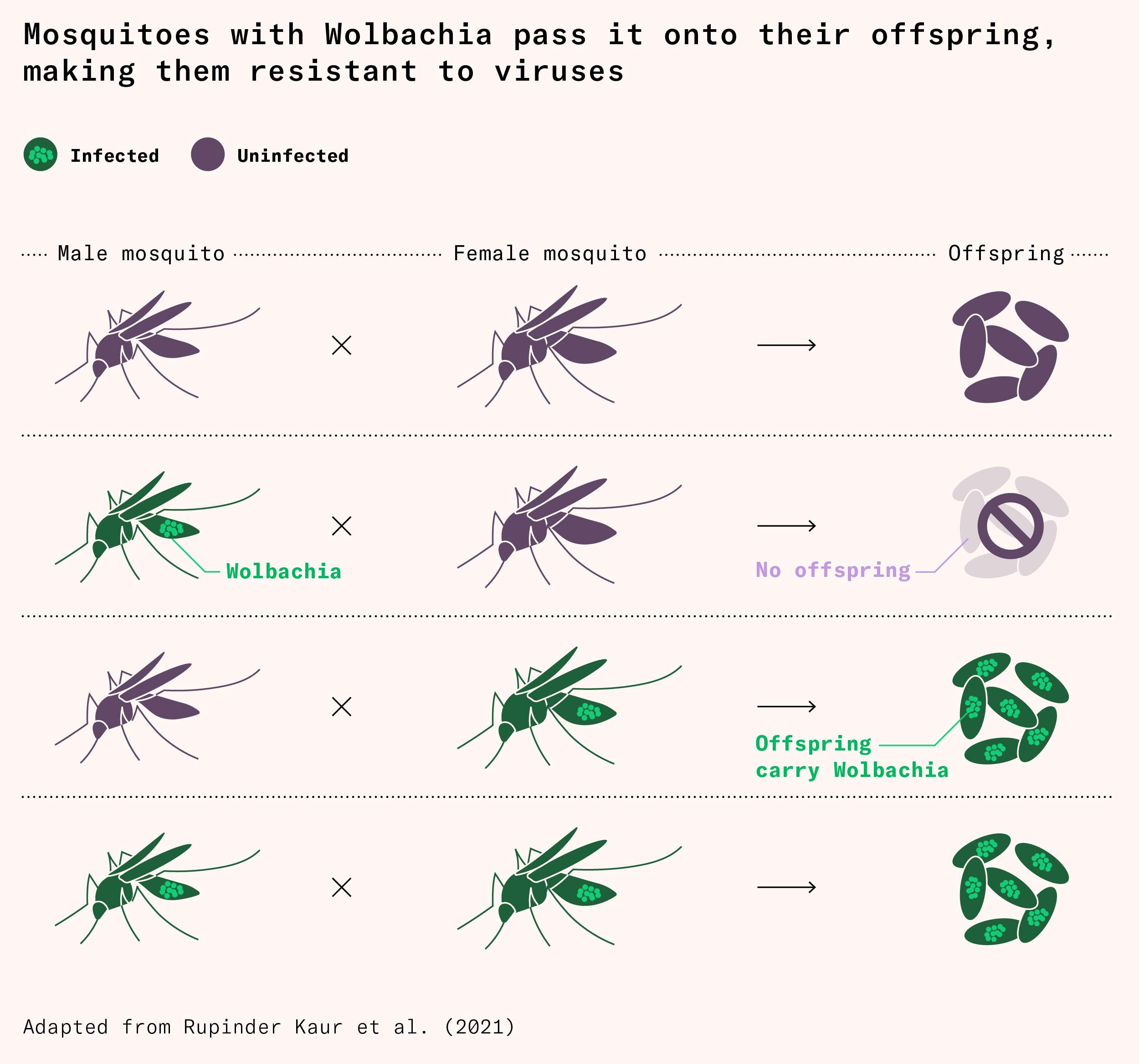
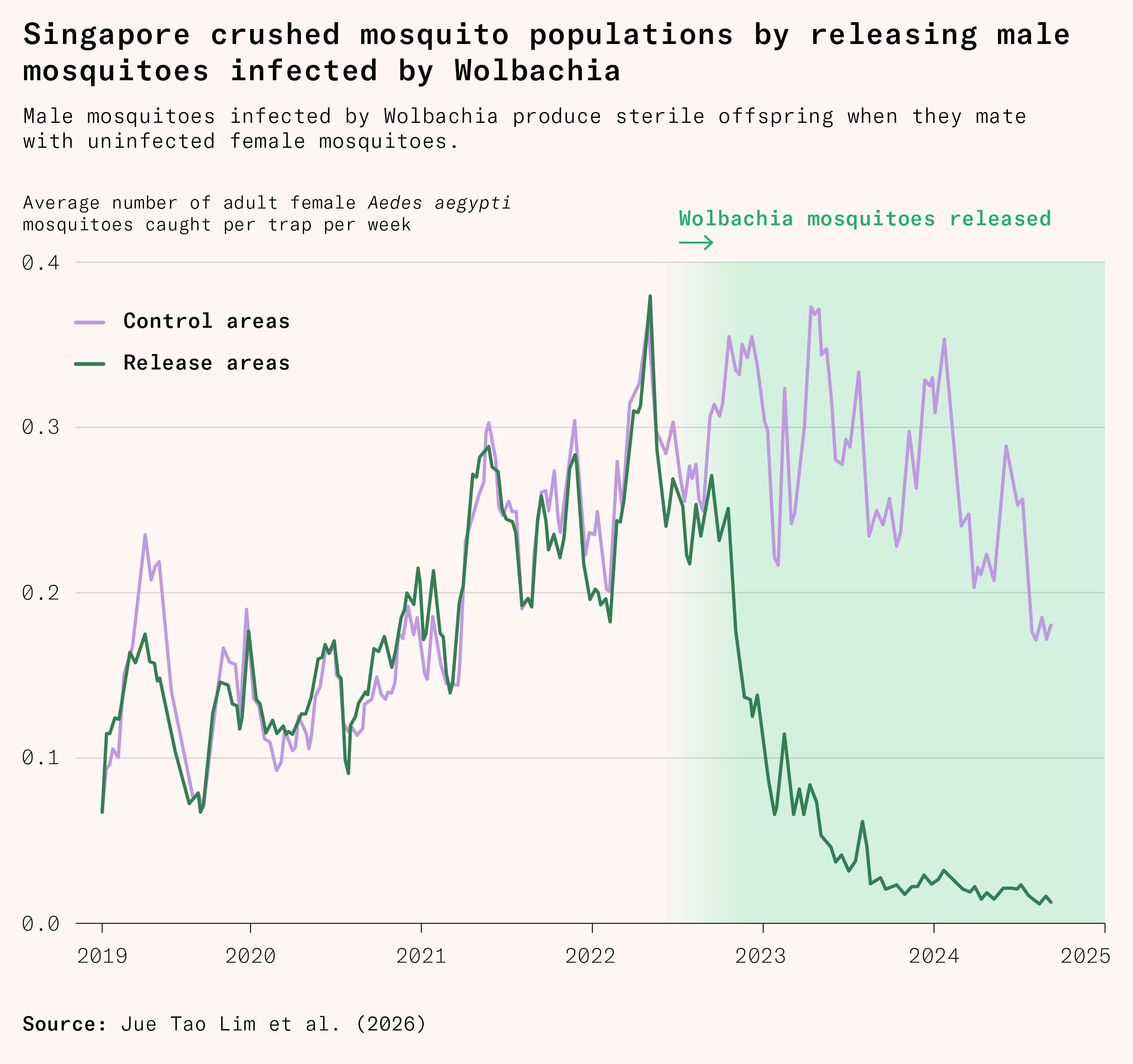
In 2009, after decades of research, scientists in Australia successfully introduced a strain of Wolbachia into Aedes aegypti. They also confirmed that Wolbachia-infected male mosquitoes that mate with wild females produce eggs that don’t hatch, making them effectively sterile without infected females to mate with. This is the basis for an alternative strategy: releasing only males has the same effect as the sterile insect technique, collapsing local populations. The approach has succeeded at the scale of cities. In a randomized trial in Singapore, releases of Wolbachia-infected males cut mosquito populations by 85 percent compared to control areas and dengue infections by roughly 70 percent.
In April 2024, after fifteen years working its way through the system, MosquitoMate became the first company to receive full nationwide commercial registration for a live mosquito biopesticide. MosquitoMate’s insects can now be deployed across the United States, subject to local approval. Mosquito control districts have moved quickly to make use of the technology, including the Florida Keys in 2025 and the San Gabriel Valley in 2026. The technology is also attracting interest from larger players. In June 2026, Google’s Debug project requested the EPA’s approval to release 64 million Wolbachia mosquitoes in California and Florida (in this case, targeting a different species: Culex quinquefasciatus, which carries West Nile virus). But it must complete the Experimental Use Permit process from the beginning, even though the basic underlying technology is the same.
Regulating biotech better
In the last few decades, biotech has developed enormously. We can edit DNA, treat diseases by silencing harmful genes, and engineer bacteria to eat plastic waste and oil spills: all things that would have sounded like science fiction not even fifty years ago. But the regulation that governs the use of these new technologies hasn’t kept pace. No major new biotech regulation has been passed since the 1980s, and the agencies responsible for review are not resourced or designed for speed. The 1986 Coordinated Framework remains the governing structure, and it divides jurisdiction according to categories designed for the previous century.
Sometimes, it’s not even clear which regulatory body should have oversight of a new technology, a question which can create years-long delays before testing even begins. Cell-cultured meat faced this problem: was it a food, and thus under the jurisdiction of the FDA, or an agricultural technique, under the jurisdiction of the USDA? The deadlock broke only when Congress forced them to split the review. In Oxitec’s case, a single early meeting to resolve the tensions would have saved years. A few years ago, Washington seemed to agree. President Biden’s 2022 executive order directed the agencies to resolve regulatory uncertainties, and they committed to formally update how the 1986 Coordinated Framework is implemented. But almost none of it happened; President Trump rescinded the order in March 2025, and the updates never materialized.
Even aside from harmonization and safety testing, it can still take years for products to be reviewed. Other programs might expedite the process. The EPA introduced a Vector Expedited Review Voucher program in 2022, which rewards companies that successfully register a novel mosquito control product with a voucher entitling them to expedited review on their next application. This ought to ensure that many of the best applications would be fast-tracked. But it doesn’t do anything about the long regulatory backlog itself. Much better would be to grow regulatory agencies’ capacity to review and approve applications, to speed up the pipeline as a whole. Currently, the EPA unit responsible for reviewing new mosquito control products is a small office that reviews a wide range of products from biochemical compounds to genetically engineered mosquitoes, and mosquito products are generally reviewed with the same protocols as other conventional pesticides, even though they raise different questions than pesticides on dispersal, inheritance, and their impact on populations.
Reforming these departments and clearing their backlogs is possible. Because of the Prescription Drug User Fee Act, passed in 1992, two thirds of the FDA’s budget for human drug review now comes from industry fees. In the late 1980s, the median time to review a new drug was 29 months; under the fee system, the targets are ten months for a standard review and six months for a priority one, and the agency now meets them in the large majority of cases. Increased staffing helped drive the speed up: it’s estimated that review times fell by roughly 3.3 months for every 100 reviewers the FDA added. The EPA, by contrast, is much more reliant on congressional appropriation, with two thirds of its budget coming from Congress and only one third from fees.
It shouldn’t have to take fifteen years to deploy effective products that can save lives. New technologies mean that mosquito-borne disease is now a choice in the United States. We have the power to eliminate it; all we have to do is choose to.

Subscribe for $100 to receive six beautiful issues per year.