
Two Dutch brothers invented a system that transformed a city previously ravaged by fires
In the seventeenth century, Amsterdam was likely the wealthiest city in the world. Global trade and local industry financed its artistic masterpieces and furnished the abundant foods and household goods that Dutch painters immortalized in still lifes and domestic scenes.
But material abundance and industrial activities also heightened an ancient danger: they added fuel to the flames of urban fires.
‘People of all ranks owned more clothes and furnishings. Curtains became far more common: easily set alight by a carelessly positioned candle, they were the source of many fires that then spread to wooden furniture and walls’, writes historian David Garrioch.
If its homes were vulnerable, Amsterdam’s factories, workshops, and piers were in even greater peril. Maintaining all those ships required stores of highly combustible pitch, tar, turpentine, and hemp. Soap makers, bakeries, sail makers, saw mills, cloth printers, picture frame makers, and the occasional alchemist contributed their own fire hazards. So did the burgeoning industries of brewing, printing, resin making, and sugar refining.
Yet Amsterdam avoided the disastrous equivalent of London’s Great Fire of 1666. In the last three decades of the century, in fact, the toll from fires dropped dramatically. Behind this improvement lay a culture of inventiveness and, just as important, what we today might call state capacity.
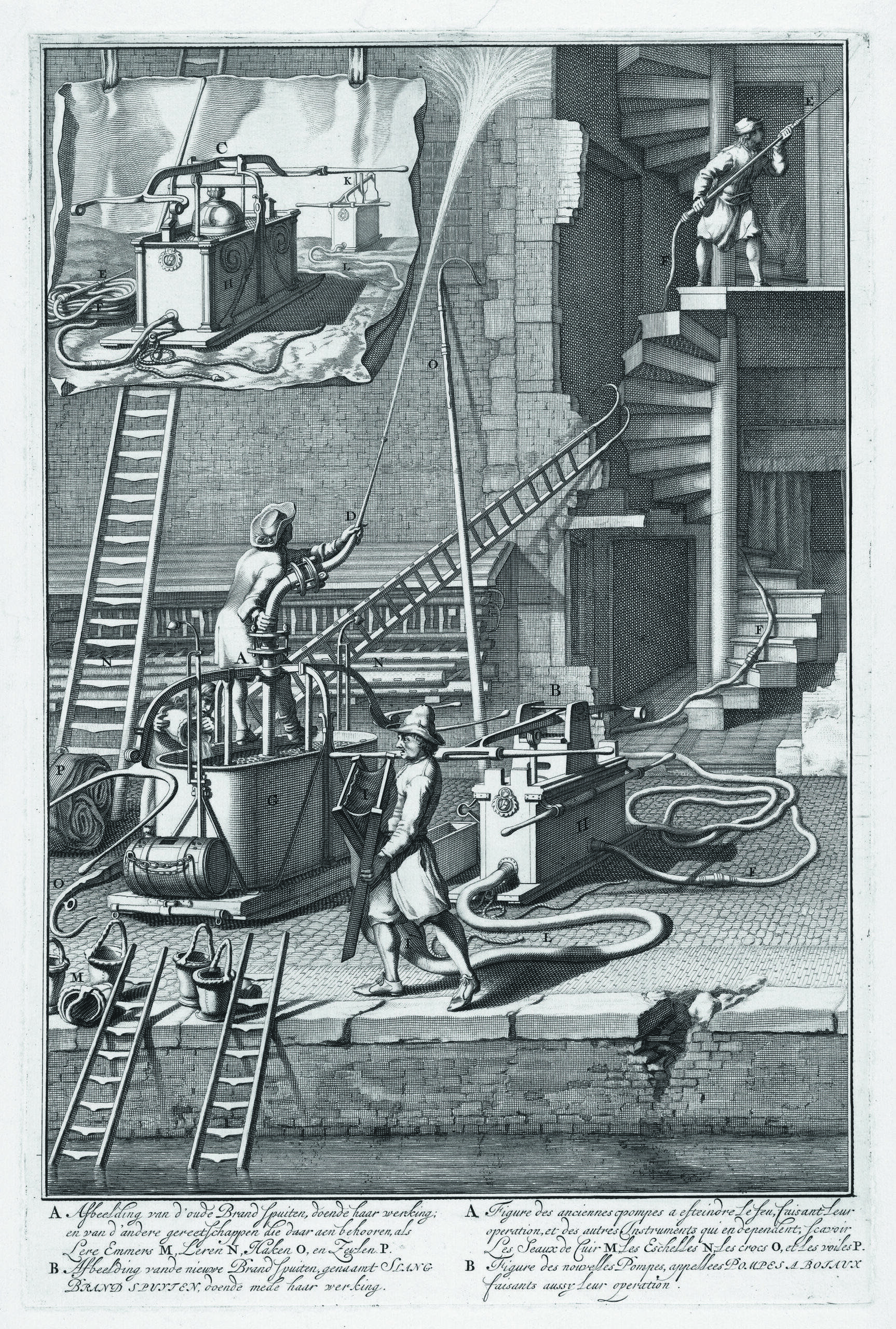
In the 1660s, the city purchased dozens of large water-pumping engines from Hans Hautsch, an inventor in Nuremberg. Dragged to the scene by a horse, each engine had a cistern whose water was manually pumped into a metal pipe capped by a nozzle. By 1670, about 60 of these engines were distributed around the city, along with ladders, hooks, tarpaulins, and more than 28,000 leather buckets. Members of four guilds – inland sailors, peat carriers, beer carriers, and grain weighers – were charged with fighting fires in their districts.
Amsterdam’s fire-fighting system was the largest and best-equipped in Europe. Neither Paris nor London had anything similar. Amsterdam’s many canals also gave fire fighters convenient sources of water. But the system was still inadequate.
On a December night in 1669, a large, new sugar refinery on the Laurier Canal caught fire when its drying oven overheated. Fire fighters rushed to the scene, bringing Hautsch engines. While some men kept the cisterns filled with buckets of canal water, others aimed the nozzles at the flames. Despite the ready supply of water, their efforts proved futile. The refinery and the owner’s house burned to the ground.
The essential problem was that fire fighters couldn’t get enough water to the roof or deep into the building, thus making it impossible to quench the fire at its origin. The streams of water sprayed only the outside of the building and the lower levels.
The loss was enormous – an estimated 195,000 guilders (perhaps $20 million today), including 65,000 for the buildings and twice that, 130,000 guilders, for the sugar and other goods. By comparison, a skilled worker earned three or four hundred guilders a year. Fire insurance was still almost a century away, making the refinery owner’s loss total. Shattered by the catastrophe, he died a few days later.
Even more devastating was a 1672 fire, which broke out on a bitterly cold February night at one of the printing offices of Joan Blaeu, a famed cartographer. The building was far from the nearest canal, and freezing temperatures made the water pumps useless
Before this conflagration, Blaeu’s printing operation had been the largest in the world, with two well-equipped shops. The one that burned seems to have been where the maps in Blaeu’s multi-volume Atlas maior were printed. A commercial hit among the Dutch elite, an edition with colored maps and illustrations sold for 450 guilders (perhaps $45,000 today).
The fire's cost was huge: 27,000 guilders for buildings and another 355,000 guilders for the plates, tools, and other goods in the printing office and woodworkers’ building, for a total of 382,000 guilders. Blaeu’s once-thriving business never fully recovered, and he died the following year.
‘This great printing office, with all its contents, was so completely destroyed that even copper plates, standing in the outer corners, melted like lead’, wrote Jan van der Heyden in a 1690 chronicle of the city’s fires.
Van der Heyden was a painter famous for his meticulously detailed city scenes – he has been called the Dutch Canaletto – and seems an unlikely fire historian. But painting was only one of his occupations. He was also an inventor with a knack for designing and managing systems.
In 1669, he proposed a plan to light Amsterdam’s streets with 1,800 oil lanterns. Surrounded by glass panes, the lamps he designed were wider at the top than the bottom to minimize shadows. They included air holes at the bottom and a chimney, thereby drawing smoke out so it didn’t dim the light. The city agreed to make and install the lamps and hired more than a hundred employees to light and maintain them. To supervise the system, they named Van der Heyden ‘director of the municipal lights’, with a generous salary of 2,000 guilders a year. By the beginning of 1670, all the new lamps had been manufactured and installed, making Amsterdam by far the best-lit city in Europe.
Van der Heyden’s account of Amsterdam’s fires, written with his son Jan Jr, highlights another system of inventions. With before and after contrasts, including cost estimates, it convincingly demonstrates the effectiveness of a new fire engine invented by Jan Sr and his brother Nicolaas, who died in 1681.
There were three critical elements to the brothers’ new fire engines. The first was the ability to pump water from a distance through a leather suction hose. This system provided a more continuous water supply and was less chaotic than relying on a bucket brigade near the fire.
Second, the Van der Heydens replaced the rigid spout with a long, flexible leather hose. Called a ‘snake’ (slang in Dutch), this hose could reach deeper inside buildings and aim more precisely at hot spots than the nozzled pipes of the Hautsch engine. Finally, the brothers added an air chamber so that water could be pumped out in a continuous, high-pressure flow rather than intermittently on the down stroke. This feature, they hoped, would keep the engine from freezing up in cold weather.
The city council decided to retrofit half the existing engines with the Van der Heydens’ suction and pressure hoses in November 1672. Before the retrofitted engines could be deployed, however, a fire broke out that proved a turning point in the adoption of the Van der Heydens’ system.
It ignited on January 12, in buildings near the harbor used to store military supplies, particularly for fire ships designed to be set alight and rammed at enemy vessels. The area was, in other words, deliberately packed with highly flammable materials, including wood shavings and sulfur. They ‘burned so furiously’, wrote Van der Heyden, ‘that the flames lighted up the whole city’.
The lone new engine arrived late. It had been on the other side of town along with an older engine, which the hauler brought first. By the time it showed up, the scene was crowded with old engines and men furiously combatting the spreading fire. ‘The fire fighters did not think that this was the time to try new and unproven things’, wrote Van der Heyden. Who could blame them? Unable to reach the main building, the Van der Heyden crew set about combatting the fire spreading to adjacent sheds. After saving the sheds, they extinguished about a hundred feet of burning rubble, clearing a safe way to bring their hoses to pump water into the primary blaze. ‘This incident showed clear as day the difference between the two engines’, wrote a triumphant Van der Heyden. ‘A single new engine, coming late and finally reluctantly put to work on what was thought to be unavoidably lost, had preserved everything that had still been standing’.
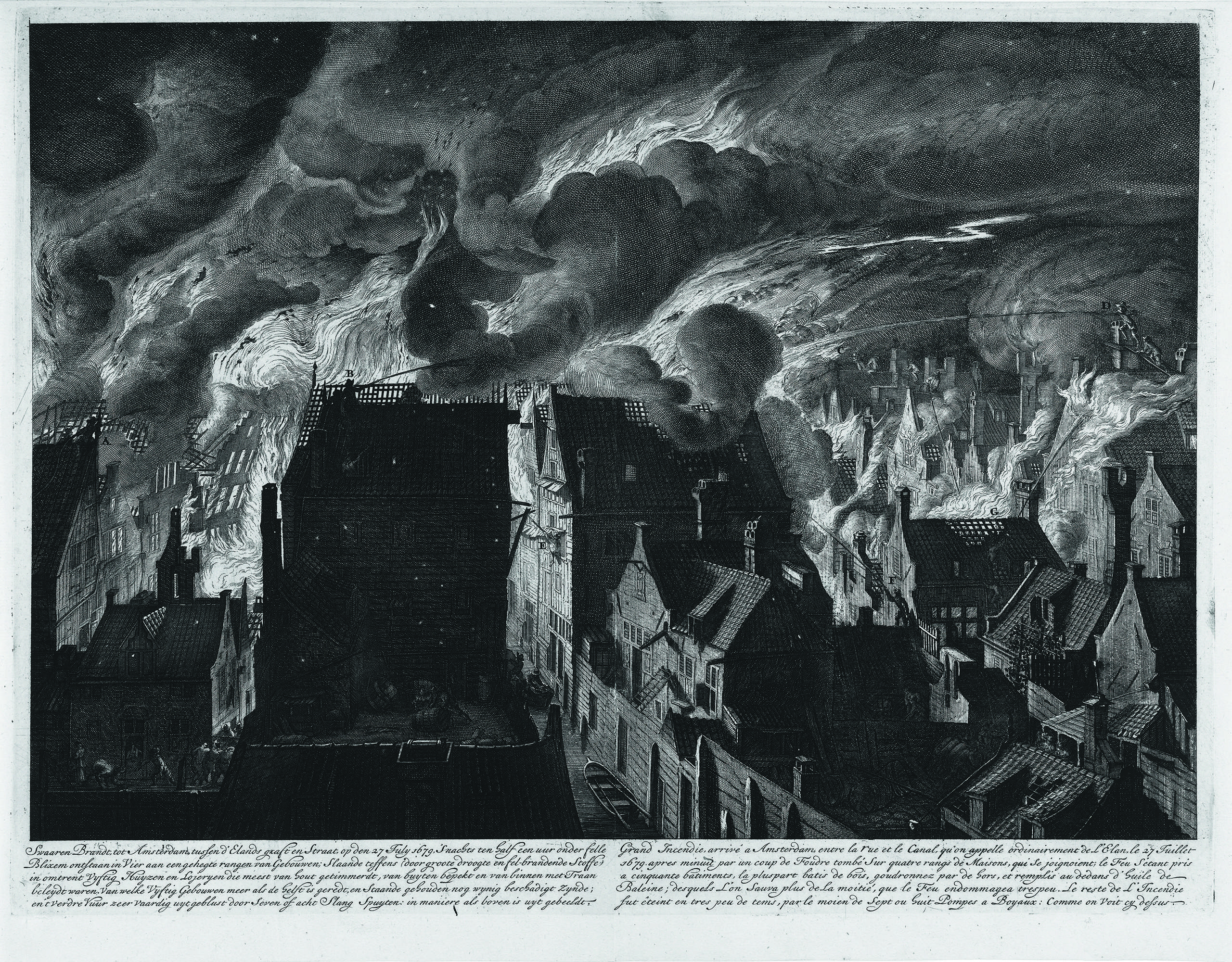
It was the final fire fought in Amsterdam using unmodified old engines. Shortly thereafter, the Van der Heyden brothers were appointed supervisors of the city’s fire engines and fire fighting equipment. The transition to new technology, and the organizational changes to back it up, took time. The retrofitted engines weren’t as portable as fully new ones, which were light enough to be carried by fire fighters without horses. After a particularly large fire in 1679, the guild brothers assigned to fire fighting petitioned the city to replace the awkward retrofitted engines with lightweight new ones. Finally, in 1681, the mayors ordered the Van der Heydens to produce enough engines to supply each of the city’s sixty districts and to draw up regulations for managing them. For instance, the Van der Heydens set up a new system of fire alarms, adding trumpeters in all the city’s towers to the alarms from night watchmen. Lamplighters, who were still under Jan van der Heyden’s authority, also got rewards for quickly reporting fires to district fire masters.
The new system ‘was honeycombed with market incentives’, observes historian Peter M Molloy in his foreword to the English translation published in 1996. ‘Watchmen who failed to notify fire fighters paid those fire fighters’ fines. Householders or shopkeepers who attempted to fight a fire before sounding an alarm were also fined’. To encourage quick responses, the first, second, and third companies arriving at a fire received monetary awards.
Fire fighters were not paid salaries, however. Each fire company was staffed with 36 residents of the district, serving under the command of two fire masters. Each man appointed had to serve a year or pay a fine of ten guilders.
‘At the beginning of the year 1682’, wrote Van der Heyden, ‘everything was new. There were new equipment, new regulations, and new people; nothing was left of the old except just enough buckets to haul water and pour it in the waterbag in its trestle.’
The new system dramatically decreased fire damage. In April 1682, fire broke out in the peat boiler of a soap maker, quickly spreading upward to two attics storing additional supplies of flammable peat. Residents of surrounding houses were still sleeping, unaware of the danger. Fortunately, three peat carriers, all members of the district fire company, spotted the blaze while making early morning deliveries. Two raced to get the fire engine while the third woke up people in the adjoining houses, including the soap factory’s owner. So fast was the response that the owner didn’t even have time to bundle up possessions to save them from the blaze. The fire was extinguished with minimal damage to the factory and none to the surrounding homes.
From 1682 to 1687, Amsterdam suffered 41 fires, with total losses of 18,353 guilders, or less than one percent of the losses from 1670 to 1681 under the previous system. It would be easy to dismiss these positive results as so much self-serving propaganda. The numbers come, after all, from the Van der Heyden account. But the audience for the book included too many people with first-hand knowledge of events – and the difference is simply too great – to permit substantial exaggeration. If six-figure fire losses were still occurring in the 1680s, someone would have noticed.
Jan van der Heyden was not just an ingenious mechanic like Hans Hautsch but someone who thought deeply about how his inventions would operate in practice, designing systems to maximize their success. Lettie Stibbe Multhauf, who translated the fire engines book and published research on the lamp lighting system, declared Jan van der Heyden’s problem-solving approach ‘one of the earliest instances of a method now called systems analysis’.
It mattered, too, that Van der Heyden’s inventions and reforms suited the ethos and political economy of his city. ‘Although the mayors and other high city officials were chosen from a relatively small group of prosperous merchant families, their interests were broadly based. They encouraged ‘useful’ inventions and actively sought to put these into practice’, Multhauf writes. Amsterdammers were famous for willingly paying high taxes and taking pride in civic monuments. They apparently thought they were getting their money’s worth. In the case of fire fighting, it seems they were.

Subscribe for $100 to receive six beautiful issues per year.