Sports solved a problem that nearly killed television.
By late January 1945, the end of World War II finally seemed in sight. American business leaders began thinking about introducing products delayed by the war. The most anticipated was nylon stockings, which debuted in 1939 only to have the new fiber diverted to military applications. Another was television, which had entranced visitors at the 1939 World’s Fair. But the new medium was a much tougher sell than high-tech hosiery.
‘Television presents a vicious triangle’, JJ Nance, a Zenith Radio Corp executive explained to Wall Street analysts. Television shows were far more expensive to make than radio programs. Producers needed advertising revenue to cover the costs. But advertisers demanded large audiences. ‘We can’t get a mass audience’, Nance said, ‘until we have provided the American people with assured continuous entertainment, pleasing enough to stimulate the buying of receivers by the million’. Hence the vicious triangle: attracting viewers required programs, which required advertising, which required viewers…

Subscribe for $100 to receive six beautiful issues per year.
It’s a dilemma every new technology platform faces – only more so. To catch on, television needed to sell hardware, create content, and find revenue. Few contemporary platforms have to do all three. Most build on an installed base of hardware. Social media gets its content free from users. In theory, TV might have paid for programming with a license fee on sets, like the tax that still funds the BBC. But Americans, accustomed to free, ad-supported radio programming over public airwaves, fiercely resisted any such suggestion.
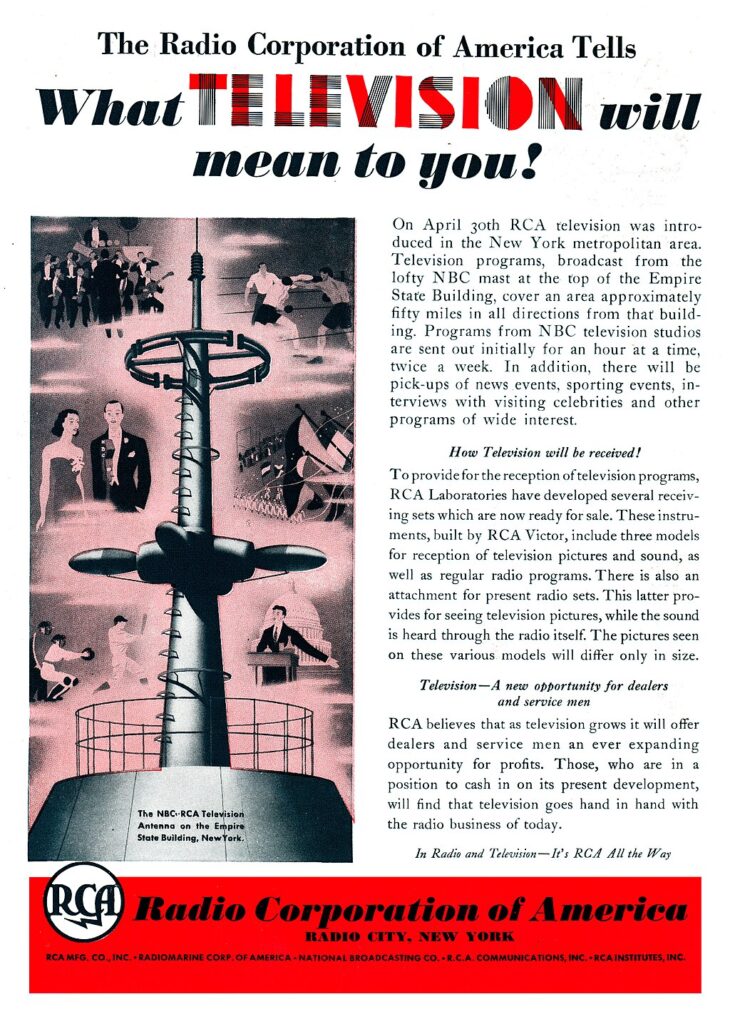

Yet just a decade after Nance’s speech, two thirds of American homes had a TV set, including 78 percent of those in cities. As early as 1948, public housing officials were already debating whether tenants in subsidized apartments should be allowed sets and antennas. Television was one of the most quickly adopted technologies in history.
To escape the vicious triangle, broadcasters exploited ready-made productions, complete with their own stages, fan bases, and well-established stars: sports. Showcasing athletic competition was the new medium’s killer app. ‘For the next few years, at least, sports coverage will be far and away the most important single element in television programming’, the sports manager for Chicago’s WGN station wrote in 1948. ‘It’s a safe bet that up to 50 per cent of television hours, both live shows and films, will be in the field of athletics’.
The postwar rematch between heavyweight boxers Joe Louis and Billy Conn in June 1946 was an early success. Broadcast from New York’s Yankee Stadium, the fight reached north to Connecticut and south to Washington, DC. Fans ‘saw everything that went on in that 24-foot square, and they saw it in much better detail than most of the 45,266 persons who paid their way’, enthused a New Jersey sports reporter, putting the TV audience at about 100,000. ‘You could hear the roar of the crowd; the count of the referee; the ring of the bell’, he wrote. A Brooklyn bar owner who crammed in 150 fans to watch his television said he’d turned away at least 500 more.
Bars were critical to television’s early success. ‘More people see television sets in bars than would ordinarily see them in showrooms’, said the director of a Chicago station. ‘The bars are helping sell sets to private homes’. Although some bartenders complained that sports fans contented themselves with a single beer rather than multiple cocktails, most reported that television brought in more customers, ultimately raising sales. Sometimes a bar would place a large magnifying glass in front of the screen to make the broadcast more visible at a distance.
TV’s early appeal can strain the twenty-first-century imagination. Broadcasts were in blurry black and white, with pictures plagued by shadows, snow, and jitters. Screens were tiny, typically about 52 square inches, and a basic set cost around $325 (about $4,400 in today’s dollars). An exceptionally well-capitalized bar might splurge on the UST Tavern Tele-Symphonic, featuring a 25” x 19” screen, at a cost of $1,995, or nearly $30,000 today. But those were rare luxuries.
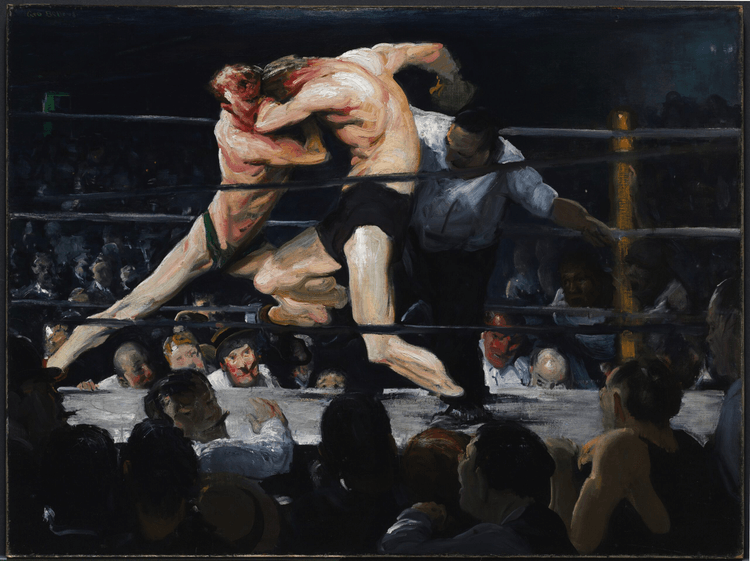
With their one-on-one action and limited ring size, boxing and wrestling were well suited to the small screen. New wrestling fans, particularly women, were a common trope in newspaper reports. ‘A lot of frail women are enjoying the sight of Danny MacShane cracking a man’s head into a steel post and having his head cracked in turn’, observed a sports columnist. Wrestling might or might not be a sport, but it was definitely entertainment.
Amid widespread fears of ‘juvenile delinquency’, television promised to keep kids out of trouble. ‘There’s no juvenile delinquency here’, proclaimed an ad for TV sets, portraying a family seated around their living room console. The tavern connection contradicted that wholesome image. Minors weren’t supposed to enter bars, but young sports fans often peered in the windows.


In response, churches, Boys Clubs, youth centers, and YMCAs began buying their own sets. On a summer evening in 1948, a Methodist church outside Philadelphia attracted a crowd of 125, mostly teenagers, to watch a baseball game between the Philadelphia Phillies and the Cincinnati Reds. Pastors around the country reported that TV was drawing in the kids. ‘Our church set is used primarily for hockey games, prize fights, and other sports events’, said a Presbyterian minister in Chicago. ‘We’re sorry we didn’t think of it before’.
Sports were so perfect for television that many feared the new medium would devastate ticket sales. ‘It’s inevitable that sports attendance will crash to a national calamity’, declared a columnist, reporting that boxing authorities in the nation’s capital were lobbying for legislation requiring broadcasters to cover match expenses. Football coach Rip Engle, then at Brown University and soon to move to Penn State, foresaw a shakeout. ‘I won’t be surprised if there are only ten college football teams left in a few years’, he said in 1949. ‘That’s what’s going to happen if games involving the big schools are widely televised’. Others predicted the death of minor league baseball. Why turn out for the local farm team when the big leagues were on TV?
Nonsense, said optimists. Veteran sports columnist Ed Danforth cited history and initial results. Baseball owners were always against change. ‘Look how they resisted the avalanche of money night baseball brought them’, he wrote. He ticked off the televised events of 1947 – the World Series, the Notre Dame-Army football game, the Joe Louis–Jersey Joe Walcott fight, the Sugar Bowl featuring the University of Georgia’s undefeated football team – and noted that they all set attendance records. ‘Big events played to capacity, whether they were televised or not’, he wrote. Television was ‘publicity for these sports and publicity that was PAID for at the source’. Television, he predicted, would only increase the popularity of sports.
Eight decades later it’s safe to say he was right. In 2024, US sports events attracted a staggering 292 million in-person fans, reports sports-marketing firm Two Circles. Far from shrinking to a handful of teams, college football games endure as a major cultural experience, and sell the most tickets of any US sport. At the same time, sports continue to support television in its many forms. Whether viewed on an enormous flat screen or a palm-sized phone, sports offer a compelling form of visual entertainment, with real stakes and unknown outcomes. And they still draw fans to bars.