It is a truth universally acknowledged, that a single man in possession of a good agricultural surplus, must be in want of a wife.
In the 1930s in the Upper Nile region of what is now South Sudan, anthropologist EE Evans-Pritchard met a Nuer woman sitting by a thatched hut with her children. In the distance, the father of her children tended the cattle. They looked like an ordinary family. But this man was not her husband. The Nuer woman was married to a ghost, and her children were officially the children of this ghost.
Among the Nuer, if a man died without leaving any heirs his kinsmen would find him a wife, in order for his name to live on. They worried that otherwise his ghost would grow restless, haunting and bringing sickness upon them. ‘A ghost likes to think of people asking, “whose son is that?” and being told in reply that it is the son of so-and-so’, the Nuer say. ‘Thus, his name continues on the lips of men’.
Subscribe for $100 to receive six beautiful issues per year.
Evans-Pritchard, who lived with the Nuer for a number of years, observed that ghost marriages were nearly as common as those between the living. Warfare and disease often claimed young men before they became fathers; childhood mortality sometimes carried off any sons they did have. In such cases, a brother, son, or nephew might marry in their name – ‘kindling the fire of the dead’. As in any marriage, cattle were paid as bridewealth to the bride’s family. The difference was that children born of the union would legally belong to the ghost, carry his name, inherit any cattle he had had while living, and, when grown, assume the ritual privileges appropriate to their ghost father.
This arrangement could lead to a curious cycle. Because the man marrying on behalf of the ghost gained a wife and children in all but name, the family’s cattle would be used next to secure marriages for his younger brothers. In some cases, the living husband died before ever contracting a legal marriage for himself. And so, in turn, his kinsmen found him a wife after death. Ghost marriage begat ghost marriage.
The variety of marriage customs
The Nuer example presents just one of a wide variety of marriage customs. For much of history, this complexity was invisible to Westerners. Northwestern Europeans assumed that their way of doing things, lifelong monogamous marriage sanctified by religion and nuclear families with male breadwinners, was the natural order. But by the twentieth century, anthropologists were returning with reports of foreign customs which challenged this notion.
Margaret Mead’s 1928 book Coming of Age in Samoa depicted a society that regarded ‘lovemaking as the pastime par excellence’ and where young women aimed to ‘defer marriage through as many years of casual love-making as possible’. At the same time Bronislaw Malinowski’s 1929 The Sexual Life of Savages in North-Western Melanesia described trial marriage among the Trobriand Islanders, where young lovers would live together for a few years in the bukumatula – the bachelors’ and unmarried girls’ house. If this relationship went well, it would lead to marriage, but it could also easily be dissolved. In other words, it resembled modern dating.
George Murdock and Douglas R White went on to formalize this scholarship with the publication of the Ethnographic Atlas in 1967, a compilation of over 1,200 cultures. Two years later, they refined the project into the Standard Cross-Cultural Sample, selecting 186 societies thought to be culturally independent and geographically dispersed. Of these societies, 31 were monogamous, 153 were polygynous, where a man had multiple wives, and 2 were polyandrous, where a woman had multiple husbands.
One thing became abundantly clear: most people in the world don’t and have never lived like Europeans. Sometimes marriage is sanctified by religion or the state; other times, it is simply what happens when two people begin living together. For some it is chosen, while for others it is coerced. Some societies prize monogamy, others polygamy, yet neither is a clear predictor of fidelity. In some cultures, both sexes can divorce and remarry freely; in others, only men have that right.
Compared to the rest of the animal kingdom, human marriage is even more aberrant. We are among a minority of animals where individuals pair up over long periods of time. Birds pair bond like us, but only nine percent of mammalian species do. For most animals, relationships last only as long as the duration of copulation.
Interfering relatives
But we are yet more peculiar. We are the only animal where third parties – parents, siblings, and extended family – routinely interfere in marital decisions, often going to great lengths to shape, delay, or prevent unions. Some societies arrange marriages at birth or very young ages. Many require long negotiations through family-approved channels. Others segregate boys and girls to restrict contact.
Well known is the segregation of women, such as the South Asian practice of purdah (literally ‘curtain’ or ‘veil’), a system that ranges from modest dress to near-complete seclusion. Lesser known is the segregation of men. Among the Enga of Papua New Guinea, boys as young as six were sent to live in men’s houses, eventually joining bachelor cults that taught them discipline and allowed marriage only after they had proven themselves. Only virgins could take part in the final initiation ritual, which involved lying open-eyed beneath a waterfall to cleanse themselves of the pollution caused by having seen a woman’s genitals. Nearby, teasing girls would sing: ‘I urinated further up this creek. Where did you purify your eyes?’

.jpg)
Whether through teasing, teaching or coercion, it is clear that marriage is rarely a private matter. It holds deep significance for the wider family and community. Time and time again it serves the same basic purpose: managing resources and building alliances. So why do strategies vary so widely?
For evolutionary anthropologists, the answer lies with Charles Darwin. People seek to maximize the number of descendants they leave behind. The best way to do this changes with the environment. And often, the best thing for me may not be the best thing for you. This creates the conditions for the conflicts that occur between the sexes, within families, and between competing groups.
Marriage for hunter gatherers
For around 280,000 years, roughly 95 percent of our history as Homo sapiens, we lived as hunter-gatherers. Today, a few such groups still exist, although these final echoes of a life we lived for millennia will soon disappear as well.
The BaYaka, who live deep in the Congolese rainforest, are one of these. Anthropologist Haneul Jang, who has worked with the BaYaka for over a decade, describes how marriages happen: an enamored adolescent couple will simply walk off into the forest and a few days later, they return and build a hut. There is no ceremony, no exchanging of vows, just a mutual understanding that they are now together. ‘There is something very romantic about it’, she says.
The young man may then do ‘bride service’, where he will live with his girlfriend’s family for a year, hunting and collecting honey with his father-in-law. At some point the relationship may dissolve. This can even happen while the couple still have small children. It will end much like it began, with one individual wandering off into the forest and building a hut with someone else.
This fluidity isn’t unique to the BaYaka but a product of hunter-gatherer societies. Groups are highly mobile, society is egalitarian – any meat from hunts is quickly shared – and there is an almost total absence of material wealth. Fathers look after their children, but they are not necessarily a primary carer. A review of over 45 studies, mostly looking at populations without medical fertility control, found that fathers have a surprisingly small effect on child survival. Other helpers, predominantly grandmothers and siblings, provide more substantial support for the mother.
While Murdock’s Ethnographic Atlas classifies most hunter-gatherers as polygynous, this is not accurate. In practice, most men are unable to support more than one wife because there is no stored wealth. Divorce and remarriage happen frequently because helpful extended families give women certainty that they won’t be left raising children alone. The lack of inheritance prevents conflict developing over having children with multiple partners, and the residential mobility means one can literally just walk away from relationships one no longer wants to be in. Consequently, women will frequently have children with two or even three men during their lifetime.
How farming promotes inequality
When farming arrived 12,000 years ago it transformed almost everything, including marriage. Defending livestock and crops became a priority, mobility decreased, and for the first time in history, wealth could be accumulated, leading to the emergence of inequality.
In the arid regions of northern Kenya, several pastoral groups still roam with herds of cattle or camels. In 1948, one Turkana man named Imana had 13 children by four wives, all of whom he was married to concurrently. His herd of over a hundred cows made it possible to support multiple households. By contrast, his neighbor, with only ten cows, had to come to terms with a single wife and far fewer children.
It’s easy to see how the arrival of wealth reshaped marriage: more cows, more wives. But less obvious is that this shift may also have been shaped by female choice. Individual men always stand to benefit, in Darwinian terms, from gaining extra wives, since they have no reproductive upper limit. Women, however, do. They have a choice: be the second or third wife of a rich pastoralist or be the first wife of a poor one. It can pay to be the former.
Taken to its extremes, some men may be so powerful and rich that they can accumulate tens, if not hundreds, of wives. The Azande recount tales of one legendary monarch, Gbudwe, who once spotted an attractive girl as he was walking through his province. Wanting her to be his wife, he stopped to inquire who she was and was told that she was one of his own wives.
Of course, given the benefits to men, not all polygyny is freely chosen. Among the Dogon of Mali child mortality is higher in polygynous households, suggesting women may be coerced into these marriages. But elsewhere, such as in Northern Tanzania, the children of polygynous fathers tend to be wealthier and better nourished.
When some men have many wives, women become a limited resource for which men must compete. Daughters become economically valuable to parents, who can demand a bride price, ranging from a couple of cows to a small fortune. To raise the funds, some men must call upon extended family networks and make the payments over several years. Among the Chagga of Tanzania during the colonial period, efforts were made to standardize bride wealth payments: 62 pots of beer, 4 slaughtered goats, 3 live goats, 15 gourds of milk, and half a cow. And that was just the pre-wedding deposit. After the wedding came a cascade of further obligations: heifers and goats to the father of the bride, and still more livestock and beer for her mother, uncles, grandmother, and brothers. To avoid disputes between sons, fathers would sometimes allocate each a sister, whose bridewealth could be used to finance his marriage.
The second consequence of polygyny is that wealth flows overwhelmingly to sons. Sons can use inherited wealth to acquire more wives and therefore many more descendants. Daughters can only carry so many children. So, across Africa, whenever cows were adopted so was polygyny and societies ended up passing property down the male line, as patrilineal families started to outnumber matrilineal ones.
In these marriage systems, divorce and remarriage become less frequent, as parents have to return the bride price, and when children inherit, fathers have a vested interest in ensuring they are his. These societies invent ways to limit the freedom of women. The Dogon of Mali, for example, have menstrual huts where women must seclude themselves during their menses. This advertisement of her cycle helps men to protect themselves from being cuckolded. He, along with the rest of the community, will know when she is fertile and so if she falls pregnant without him visiting her he knows the baby isn’t his. This system appears to work. Among the Dogon three religions coexist: Christianity, Islam, and the indigenous Dogon faith, which requires use of the menstrual hut. Genetic data from fathers and sons of the Dogon of Mali found that nonpaternity (a child not being genetically the offspring of their father), though uncommon, was slightly lower when mothers used the hut than when they did not, and that there were higher rates among Christians, whose women are not obliged to signal menstruation. Among Muslims, nonpaternity was no higher than among adherents of the Dogon religion since women must still declare menstruation and refrain from prayer, an equivalent signal of fertile periods.
These controls apply to both married and unmarried women. Unmarried Dogon girls must also use the menstrual huts, reducing the chance of unwittingly marrying an already pregnant woman, while socializing girls into institutions of control from a young age.
Parents can also command a higher bride price for daughters seen as compliant and chaste. Some scholars have suggested that female genital cutting, widespread in Sub-Saharan Africa, functions as a signal of virginity, allowing parents to secure better marriage terms. The evidence is mixed: cut girls do not consistently receive higher bride prices. But they are less likely than uncut peers to report more than one lifetime sexual partner, suggesting the practice does control their sexual freedom.
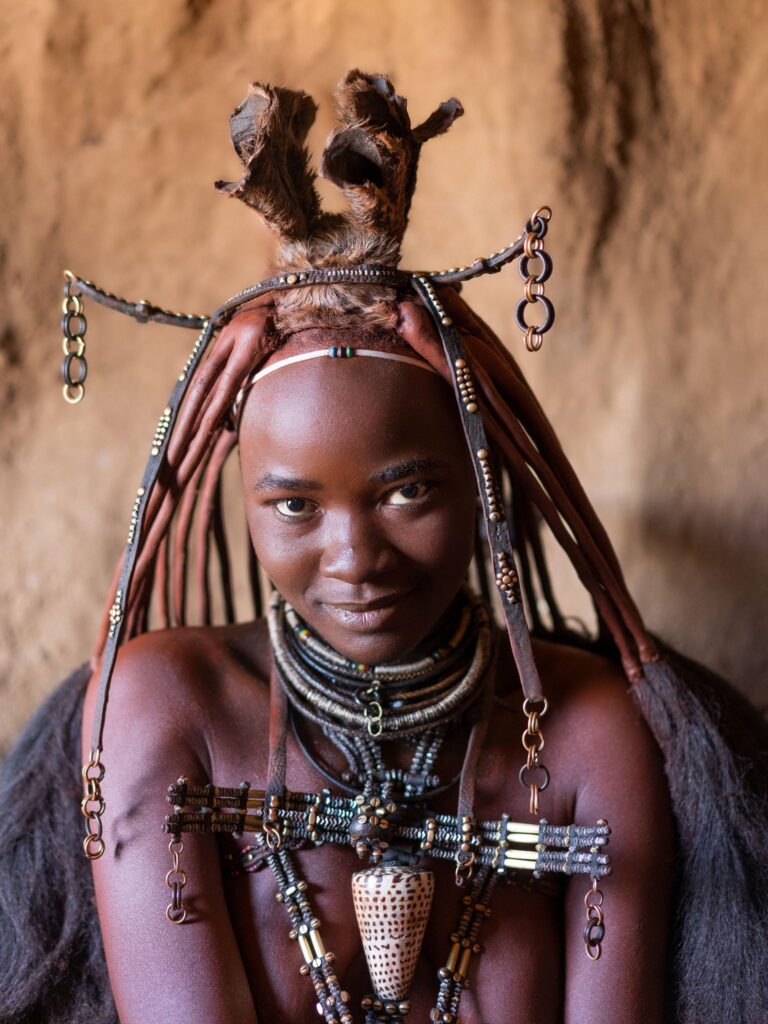
The usual pattern is that pastoralists are inegalitarian, inequality drives polygyny, and polygyny drives male control of women. But there are exceptions. Known for their distinctive hair coated in a paste of fat and red ochre, the Himba of Namibia are pastoralists among whom polygyny is common. Yet they are relaxed about infidelity, and many women have boyfriends outside of wedlock. In one sample the child was not biologically the husband’s in 49 percent of cases. There is no cuckoldry, and the Himba know exactly whose children are whose. But her husband helps raise them and pays for their marriages. He doesn’t seem to mind, knowing that the same behavior is the rule in the households where he has fathered children. Men expect their wives to see their boyfriends when they are away but not to flaunt it in front of them. ‘It’s when he stays for tea in the morning, that is when it really upsets me’, described one Himba man.
What makes the Himba so different? For one, the bride price is considerably smaller than in other pastoralist groups: typically only one or two cows and some goats. Second, most inheritance passes matrilineally, from a man to his sister’s sons. That blood line is guaranteed: he knows he and his sister share a mother and that her child is truly hers. These two features – a modest investment in non-biological children and the assurance of relatedness through the female line – help men to accept high levels of nonpaternity within their marriages.
Nor is polygyny confined to Africa. When Islam emerged in the seventh century, Quranic law sought to cap men at four wives, a limit that suggests the practice was widespread, at least for elites who could afford it. Today, the same logic plays out under different currencies. In Papua New Guinea men with a bik nem, literally a ‘big name’, once used pigs and shells to secure multiple wives. But with the rise of mineral extraction, wealth has shifted. Today it is the dak glas kar men (men with dark glasses and cars) who attract multiple women. As with the pastoralists, sometimes it pays to be the second wife of a rich man than the first of a poor one.
Monogamy and primogeniture
So how does one explain the parts of the world, like Europe and large parts of Asia, that are unequal yet predominantly monogamous? The spread of monogamy is often credited to Christianity, but restrictions on polygyny long predate it. The code of Hammurabi (1750 BC) let Babylonian men take a second wife only in rare cases, such as when the first wife was infertile. In ancient Greece and Rome, monogamous marriage was the only legally recognized union.
But even though Roman men were expected to have one wife, they often kept mistresses and fathered many children by their slaves. Similarly, Confucian family law recognized one principal wife for lineage and ritual, but allowed for concubines. Together, these exceptions to the monogamous rule may help explain why anthropological evidence finds that monogamous and polygynous societies have similar variations in male reproductive success.
The fact that many ‘monogamous’ cultures allow for elite men to have concubines and mistresses highlights the difference between a ‘mating system’ and a ‘marriage system’. Marriage might be more about managing resources than who you have sex with. Monogamous systems, therefore, may have evolved to limit the transfer of resources, rather than as a form of monogamous mating.
In this explanation, men forgo their right to multiple wives when the whole is more than the sum of its parts, and dividing their wealth among many heirs would reduce its total value. You see this clearly with farming, where dividing land into smaller plots reduces its productivity compared to keeping it as a single estate, a problem that doesn’t occur when dividing a herd of animals. This issue becomes especially acute once there is no new fertile land to expand into – a situation that occurred across Europe in the Middle Ages. This might explain the rise of unigeniture, where only one son inherits.
Under such an all eggs in one basket strategy, a man needed to be sure this son was his. So women traded their faithfulness in exchange for an agreement that only their children were legitimate heirs. Virginity was prized, and divorce could become almost impossible. Across the world, where paternal investment is higher, so too is sexual jealousy.
While women’s sexuality was strictly controlled, men were not faithful, and many would father children out of wedlock. But legislative and institutional systems were built up to exclude these bastard children. Unlike polygyny, where women were the limited resource, under inegalitarian monogamy rich men were. Daughters went from being an asset to a cost as parents had to endow them with large dowries to compete for the few inheriting men.
Nevertheless, many of these societies ended up with partible inheritance while still remaining monogamous. After the French Revolution, the government imposed the equal partition of assets among children. Unable to choose just one heir and faced with the over-division of assets, families limited the number of children they had, possibly helping explain why France was the first European country to exhibit declining fertility rates. The same trend has been found in Sub-Saharan Africa. Individuals from ethnic groups where inheritance is shared between all children have lower fertility rates than those from ethnic groups where a single heir is chosen.

Norms are sticky and can become separated from the underlying factor that caused them to originally evolve. Similarly, once evolved, the behavior can take on new functions. Limiting inheritance to the children of one woman is beneficial to that woman, and she has a vested interest in maintaining monogamy beyond a world of large agricultural estates. On the other hand, disinherited children are disadvantaged under such a system and might undermine it as they become more numerous.
The end of marriage systems
In contemporary Western settings, things seem to have changed once again. Many people are monogamous and have children with a single partner, much like our agricultural forbearers. But others divorce and remarry, similar to hunter-gatherers. Young couples often live together before deciding whether to commit, like the trial marriages of the Samoans. True polygamy is usually illegal, yet some rich divorced or widowed men can attract young second wives, who can bear them a new set of children. Ethical non-monogamists are a growing and vocal minority. To an outsider, it may seem like we have no marriage system at all.
Traditional controls over marriage have weakened. Couples now choose for themselves, usually for love. The disappearance of bridewealth, dowries, and kin-arranged unions has reduced family involvement. While this might feel like a long steady transition for the West, it’s unfolding rapidly in many parts of the world today.
As states expand schooling, boys and girls mix freely. Mobile phones let them talk privately. Rural-to-urban migration brings people from different ethnic groups together, and when they marry, neither tradition quite applies. Removing the involvement of third parties makes marriages easier to enter and leave. One woman from the El Molo, a small fishing community on the shores of Lake Turkana in Kenya put it bluntly: ‘in my time, your husband could beat you badly and you would stay. Today, the smallest thing, and they divorce’.
Ironically, Christian missionaries may have had similar effects. In Melanesia they tried to ban bachelor cults and introduced mixed churches. They preached chastity, while also inadvertently undermining the indigenous systems that had once regulated informal relationships.
Less obvious is how changes to wealth and inheritance might also make marriage more fluid. In contemporary Western societies, unigeniture is either considered wrong or is illegal; we no longer differentiate between legitimate and illegitimate offspring; and children inherit from both parents. Women no longer need to ‘trade’ their fidelity for economic security, and men may well be less territorial (cuckoldry rates range between one and three percent in the West). With women fully integrated into the workforce and earning similar salaries to their husbands, there is little keeping them in relationships they do not enjoy. And fathers who wish to divorce assume that the mothers of their children will be fine raising children alone with the support of their family, the state, and their salaries.
There has always been a tension between the stability of marriage and the freedom of individuals. This is an important reason why divorce rates drop as soon as couples have children and part of why they remain lower among higher socioeconomic groups. In a social milieu where buying a home requires two incomes and raising children has become increasingly expensive, requiring support and education well into their twenties, a complementarity of roles emerges. If you have little chance of buying a home and fewer payoffs to investing in the education of your children, then it is easier to walk away.

The tradeoffs between one or many partners, a single or multiple heirs, control or freedom, have shaped marriage for as long as humans have existed. These tugs of war explain the vast variety of relationships we see around the world. Marriage is not fixed but a tool to build connections, secure wealth, and ultimately to pass on genes. If marriage has a nature, it is to be reshaped to fit the world around it. In a world where many of the familiar constraints have disappeared, perhaps all that is keeping us together is love.