How a single unappetizing shrub became dozens of different vegetables.
Every crop we consume came from a wild ancestor. Through breeding, people selected for bigger grains, juicier fruit, more branches, or shorter stems – gradually turning wild plants into improved yet recognizable versions of their originals. The rare exception is Brassica oleracea, wild cabbage: the origin of cabbage, bok choy, collard greens, broccoli, Brussels sprouts, cauliflower, and much else.
Wild cabbage is unassuming: some untidy leaves and a few thick, coarse stems on the browner side of purple that poke out from the soil. Nothing about it looks appetizing.
Subscribe for $100 to receive six beautiful issues per year.


Nevertheless, many cultures have recognized something special in this plant. By selecting plants with denser layers of leaves, ancient people created modern cabbage and kale. Others bred for the inflorescence, a dense bundle of small flowers that forms the head of cauliflower and broccoli. By favoring large, edible buds, thirteenth-century farmers living around modern day Belgium created Brussels sprouts. Under different selection pressures, Brassica oleracea has become German kohlrabi, or Chinese gai lan, or East African collard greens.

This level of morphological diversity is unusual. Modern tomatoes, for example, vary in size, shape, and color, but are all recognizably tomatoes. Since the 1920s, scientists have worked to understand how Brassica oleracea was domesticated and to deepen our knowledge of evolution and artificial selection.
By combining modern genetics, genomics, and molecular biology with linguistic, historical, and sociological sources, researchers are now beginning to develop conclusive answers.
Cabbage architecture
Domesticating a plant means prioritizing certain structures over others. Wheat shoots are completely inedible, so farmers have bred plants to focus on their grain. Modern wheat typically grows to around waist height; a few hundred years ago it was closer to head height. These shorter, modern wheat ears also produce more and larger grains than ancient species.
Whereas other plants have a single most useful element, such as the grains of wheat or the fruit of tomatoes, wild cabbage has many. Although people didn’t know about it until the twentieth century, Brassicas are high in fiber and micronutrients like calcium, iron, and vitamin A.
Genetic sequencing has shown that kale is the modern Brassica oleracea crop most closely related to wild cabbage. Early farmers likely started by selecting plants with the largest or most palatable leaves and replanting their seeds. By around 400 BC, after hundreds of generations of selection, the plants became more extremified. This resulted in modern kale, composed almost entirely of leaf, but with little in the way of shoots, buds, or inflorescences. Later, farmers focused instead on buds or stalks. By the time written records appeared, we had already inherited most of the main categories of brassica cultivated by our ancestors.

A plant’s above-ground architecture develops from a group of cells called the shoot apical meristem. These stem cells generate every part of the plant’s structure above the soil. Whether they become shoots, leaves, or inflorescences is determined by the meristem’s stage of life. In the earlier vegetative stage, the stem cells produce leaves, while in the later reproductive stage, they grow into inflorescences. This is why no one has bred a plant that has the leaves of a cabbage and the head of a broccoli.
When ancient humans selected for certain architectures, they were really altering the movement between these stages, selecting for longer in the vegetative or reproductive stages.
Cabbage genomics
In the last few years, genomics has offered an explanation for Brassica oleracea’s unusual adaptability. Ancient wild cabbages underwent a process called polyploidy. Humans are diploid, meaning that we usually have two copies of each of our 23 chromosomes. Many cabbage varieties are triploid or even more complex.
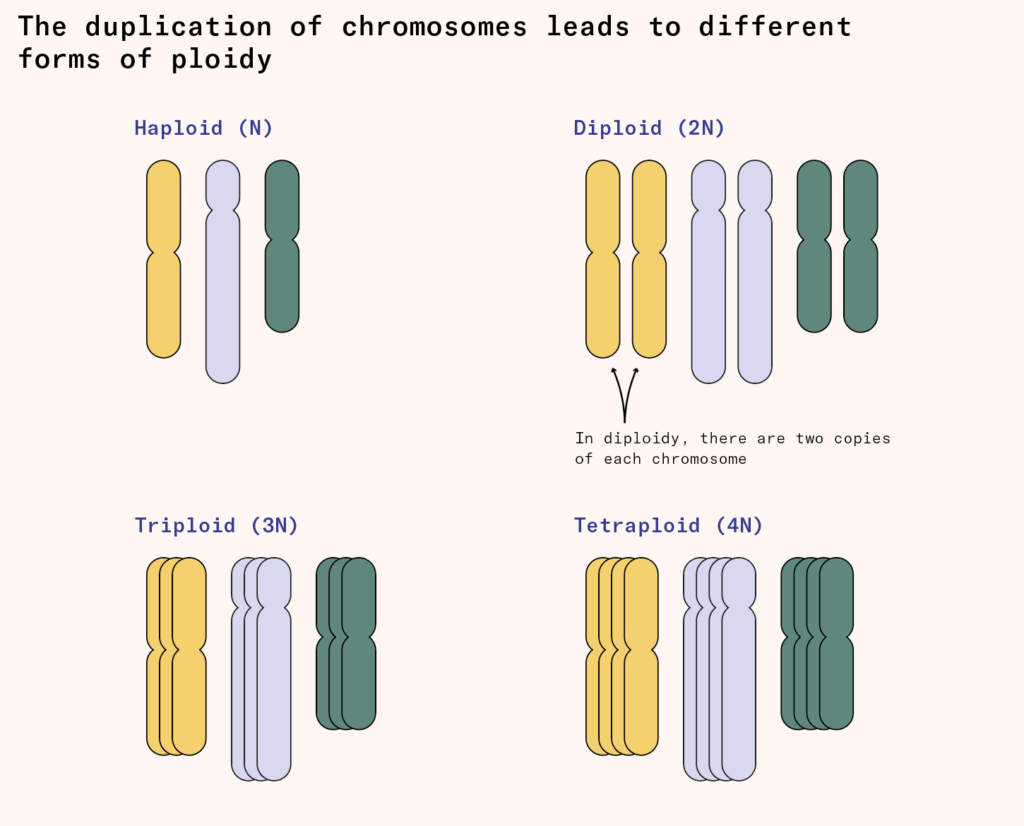
The more polyploid a species, the greater its capacity for gradual evolution. For haploid species like ants, which have a single chromosome set, mutations routinely result in certain death. Diploid species, like humans, can tolerate more genetic experimentation. A single mutation in both copies of HBB causes sickle cell anemia, but the same mutation in a single copy of the gene can confer greater resistance to malaria. Triploid plants, with multiple backups of every gene, take this even further. Harmful mutations are masked by healthy copies, reducing risk while allowing much richer genetic diversity than would otherwise be possible.
Polyploidy sets the stage for our Brassica oleracea varieties, but someone had to push wild populations to create more leaves, buds, or inflorescences to create the crops we know today.
Cabbage archeology
Archeological evidence of Brassica oleracea domestication goes back thousands of years. Fossilized samples of wild and early domesticated varieties can be found across Europe, North Africa, and the Middle East. Domesticated Brassica oleracea reached China around the seventh century, and by the eighth it had been bred into an early form of gai lan, or Chinese white kale.
But like genomics, traditional archeological methods don’t tell us where Brassica oleracea originates. Our earliest samples of cabbage seeds date to around the sixth century BC, but no clear evidence supports their cultivation prior to the fourth. No pottery with biological residue suggests the cooking of cabbage, nor do contemporary illustrations depict anything resembling them. Fossilized seeds are difficult to classify: samples are just as likely to be turnip or canola as they are to be Brassica oleracea.
As a result, researchers have turned to linguistic methods. Unlike ancient Egyptian, Celtic, or Fertile Crescent cultures, Latin and Greek sources include frequent references to ‘caulis’ or ‘krombe’ respectively, which likely refer to early forms of domesticated kales and cabbages. Ancient Greek texts are particularly rich: they include recipes, myths about cabbages growing from the sweat of Zeus, commonly used idioms such as ‘μὰ τὴν κράμβην’ (roughly translating to ‘by the cabbages!’), and a wide variety of synonyms.
Literary analysis also supports the theory that the first domesticated varieties initially focused on the leaves, as Ancient Greek distinguishes between distinct wild, curly-leaved, and smooth-leaved varieties.
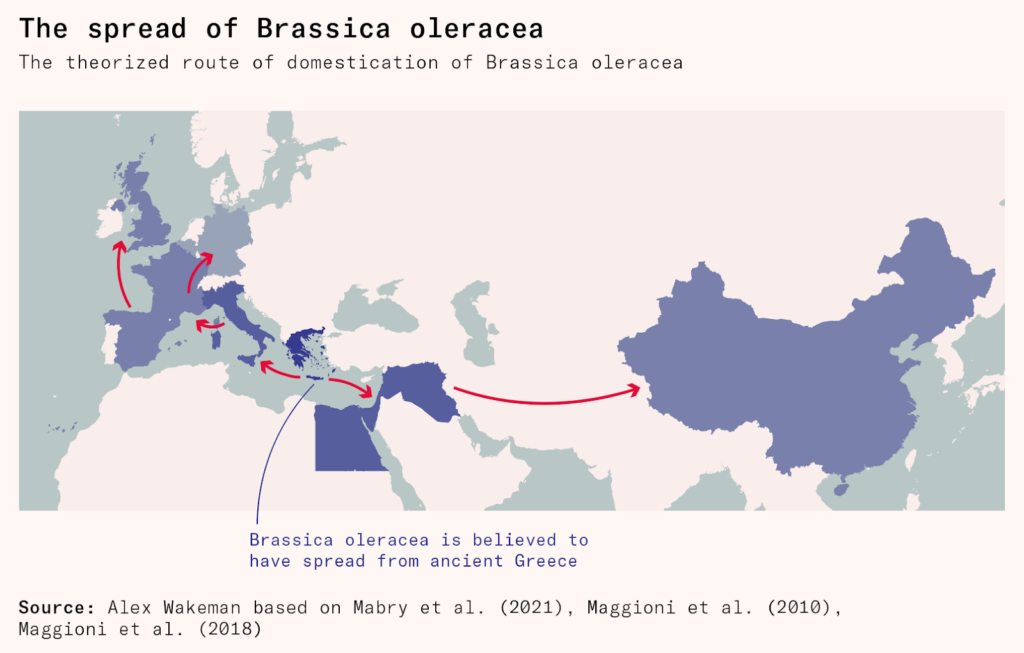
Assuming that Greeks in the Hellenistic period had cabbages, ecologists modeled the potential range of Brassica oleracea based on the predicted climate of ancient Italy and Greece between the fourth and second centuries BC. This narrowed down the likely range to the coasts and islands of the Aegean Sea.
So wild cabbages were probably first domesticated into leafy vegetables in ancient Greece, before being spread to around the Mediterranean, then northern Europe and Asia (probably by the Romans). Their genetic makeup made them highly adaptable, allowing new varieties and new feral populations to emerge wherever they were introduced.
What’s next for cabbages
Cabbage’s adaptability, which once allowed it to produce such a wide variety of useful crops, will make it equally valuable in the future. Many of the varietal differences may have first arisen as the plant adapted to new climates. Brussels sprouts not only look distinct from broccoli but thrive in cooler climates, such as those in Belgium rather than the Mediterranean.

Wild populations must survive on their own, without irrigation, fertilizer, or pesticides. These varieties are naturally more resilient to climate change and to pests. By studying the differences between these feral cabbages and their cultivated relatives, we might identify ways to improve today’s plants. Most of broccoli’s genetic diversity resides in landraces, uncommon varieties found in a localized area and not grown as part of industrialized global agriculture. These varieties could hold countless useful alleles that could be bred back into modern crops.
The evolution of cabbages reflects our own history: how human culture has reshaped a wild coastal plant into a family of vegetables that now feed billions. As climate, culture, and technology change, so will the cabbages we grow. And like the farmers of the past, we’ll keep sculpting them one generation at a time.