Clean drinking water is a modern miracle. But it has become expensive, and it doesn’t need to be.
San Francisco has some of the strictest environmental rules on the planet. The city has legally committed itself to sending zero garbage to landfills by 2030 and to using 100 percent clean energy by 2040. It was among the first to ban plastic bags and new gas boilers. It has twice been named the number one city in America for clean energy.
Yet in 2019 the federal Environmental Protection Agency ordered the city to take action to limit its alleged contamination of the Pacific Ocean. In oral arguments before the US Supreme Court, the EPA’s lawyer condemned the city’s ‘decades-long failure’ to update its sanitation systems. This order came on top of an existing mandate requiring San Francisco to spend almost $11 billion, or $13,000 for every man, woman, and child in the city, updating its sewage systems.

Subscribe for $100 to receive six beautiful issues per year.
San Francisco and other cities in a similar situation are not delinquent on sanitation. Instead, the EPA is setting water mandates that far exceed what even the most progressive cities think is necessary. These mandates drive up the cost of water, stymie housing, and burden city budgets.
Americans open a tap and get water much like their parents and grandparents did, but the price of water and sewer for households has more than doubled since the early 1980s, adjusted for inflation. American households in large cities now spend about $1,300 a year on water and sewer charges, even though per-capita use has actually decreased.
The roots of America’s water problems lie in the 1970s. Since the Clean Water Act of 1972 and the Safe Drinking Water Act of 1974, federal environmental rules have ratcheted up. Although state and local water systems had spent the previous century implementing massive improvements in water quality, national regulators treated these systems, supervised by local voters, as delinquent and needing prodding to reform.
Water policy parallels nuclear power, similarly forcing operators to reduce risks, no matter how trivial, and increasing costs to the point where nuclear is expensive and seldom used. This is another example of ‘safetyism’, the tacit ideology that the government’s main goal should be to minimize risks rather than balance them against benefits.
The triumph of urban water
The broad-based provision of clean water in the nineteenth and early twentieth centuries is one of the great successes in the history of civilization. The US, as did many other countries, accomplished this primarily through local government.
For most of history, cities were demographic sinks. More people died in them than were born, so they needed constant replenishment by migrants from the countryside. Urban areas remained deadly even into the early twentieth century. In 1900, infectious disease death rates were 75 percent higher in the largest American cities than in rural areas. Pathogens, especially waterborne ones such as cholera, typhoid fever, and dysentery, caused 40 percent of these deaths. Yet just three decades later the largest urban areas had slightly lower death rates from infectious diseases than rural areas did, with infectious diseases now causing only 15 percent of deaths.
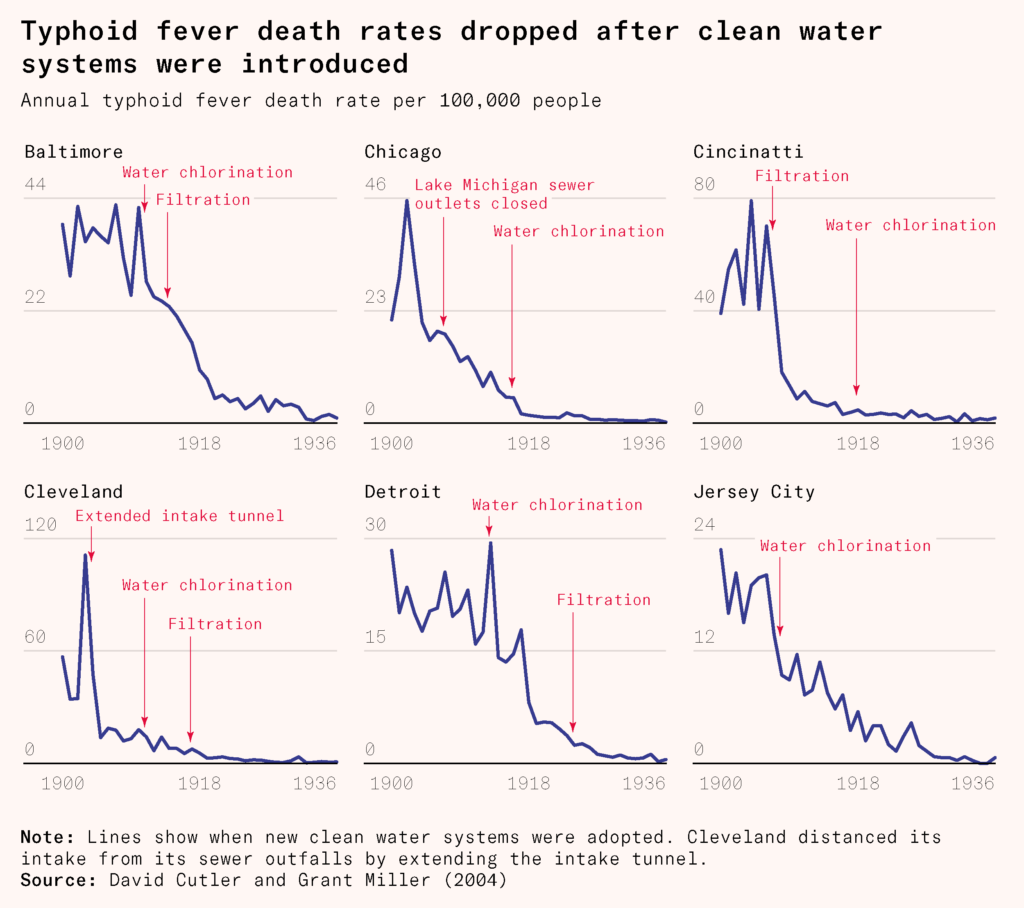
By the 1940s, infant mortality had collapsed, long before the massive scaleup of penicillin production during the Second World War. Researchers tried to tease out the different mortality rate impacts of introducing new water technologies, such as filtration and chlorination, by looking at how mortality rates dropped in different cities in the late nineteenth and early twentieth centuries. Different technologies were installed in different cities at different times, but waterborne disease mortality dropped in almost every city very soon after water treatment was installed. The researchers concluded that half the overall mortality, two thirds of the child mortality, and three quarters of the infant mortality reduction in the early twentieth century were down to clean water.
These clean water successes resulted from patient and dedicated work by policymakers and scientists. A few decades after cities began installing large, publicly owned water systems in the mid-nineteenth century, governments and private individuals made a concerted effort to clean them.
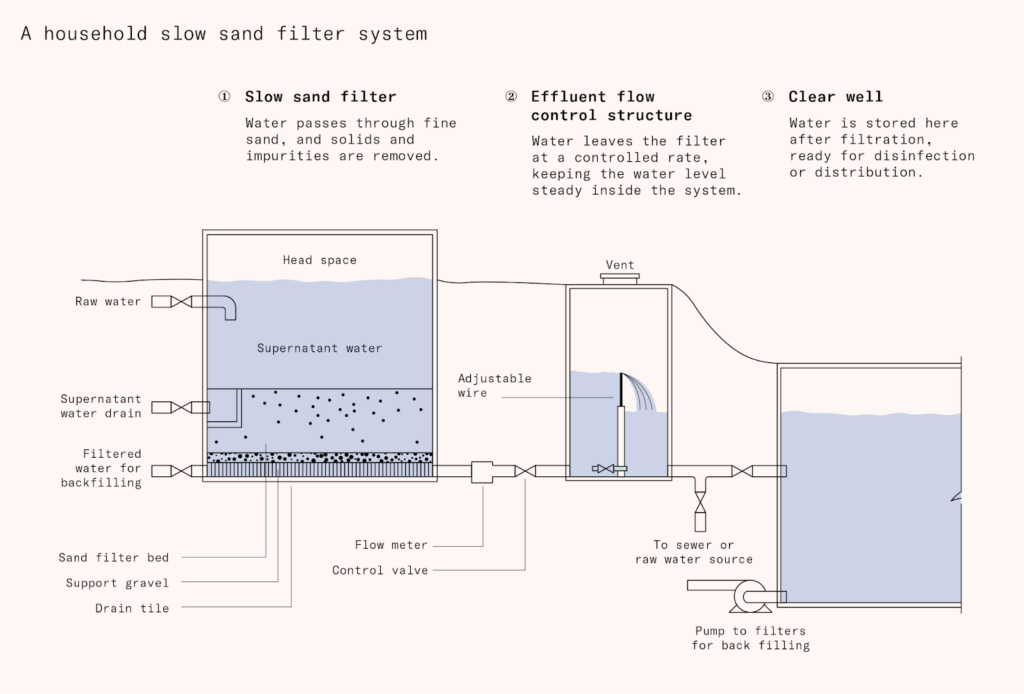
In 1872, Poughkeepsie, New York opened the nation’s first ‘slow sand’ or ‘English’ filter, which allowed water to trickle through fine-grain sand beds that absorbed most solids and many pollutants. Thirteen years later, Somerville, New Jersey created the first urban ‘rapid-sand’ or ‘American’, which pushed water through coarser sand and gravel for faster cleaning and allowed frequent backwashing to prevent the build-up of pollutants. In the early twentieth century the chlorination of water allowed water systems to use minute amounts of chemicals to kill massive amounts of bacteria.
Beginning around the time of the Civil War, cities such as Chicago started creating comprehensive sewers, with ‘intercepting’ sewer lines to collect dirty water from multiple places and drop it farther away from residents. Chicago’s downtown was raised an entire story with jackscrews to allow their installation. Chicago later took this further by building the Sanitary and Ship Canal, reversing the Chicago River’s flow to bring the sewage away from drinking water intake pipes in Lake Michigan.
In the early twentieth century, cities began creating sewage treatment plants, which used chemical coagulants, often from aluminum salts, to bind and settle solid contaminants like feces. These cities began to use ‘activated sludge’ treatment, employing bacteria to decompose feces and other organic matter. The treated water was then piped to a clarifying tank, to separate the clean water from the bacteria-laden sludge that settled at the bottom of the tank.
These modifications were driven primarily by local governments, but states also pushed for improved water quality. In 1878, Massachusetts passed a pioneering water control pollution law that forbade cities or industry from dumping human waste or pollutants into rivers and lakes and gave the state board of health authority to examine water quality and stop polluters. Nine years later, the board established the Lawrence Experiment Station, the world’s first water-pollution research center.
The growth of these local and state systems of water provision and pollution control was an unalloyed triumph that created our familiar urban world.
Nationalizing water problems
The original drive for cleaner water involved hundreds of cities and thousands of politicians, engineers, voters, and activists pushing to improve their systems while weighing the costs and benefits of new public works. This changed in the 1970s: the issue was centralized, and the locals who benefited from and paid for water improvements lost control.
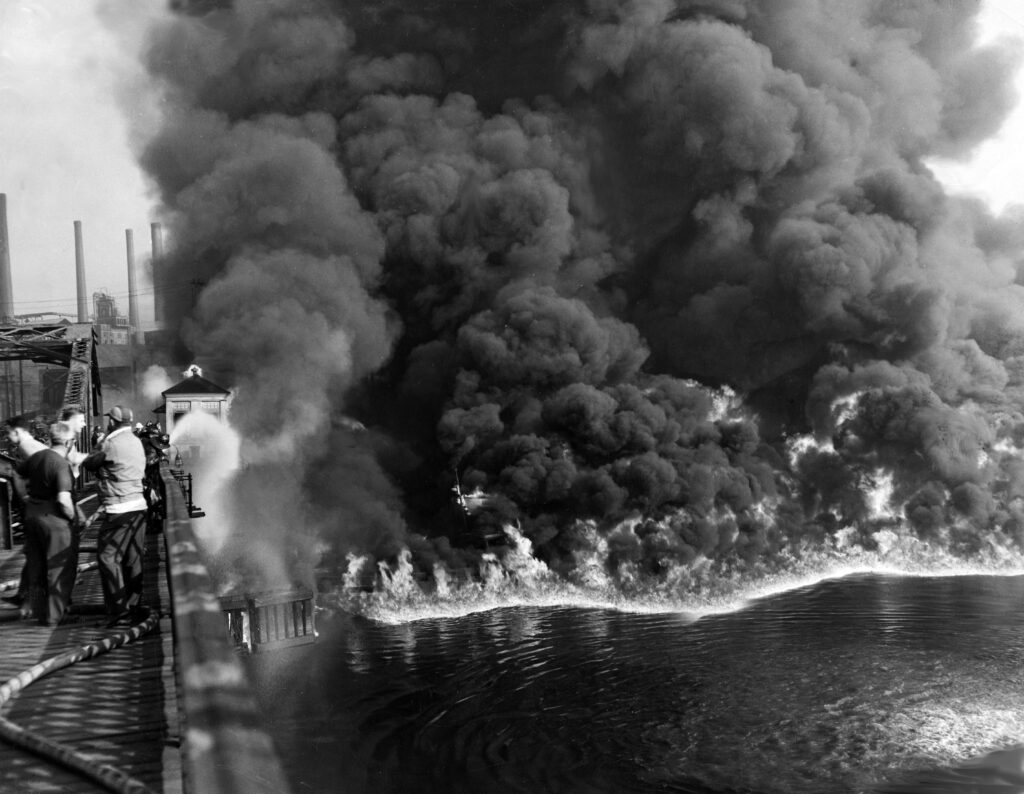
In 1969, the oil-laden Cuyahoga River in Cleveland caught fire. This had happened repeatedly over the preceding decades, and this particular fire was extinguished in half an hour. But it received national media attention, including inspiring a popular Randy Newman song, ‘Burn On’. This event and others, including an oil spill that had coated beaches in Santa Barbara that year, convinced activists that state and local governments were derelict in their duty to protect their citizens’ water.
Two Senate staffers, Tom Jorling, a Republican, and Leon Billings, a Democrat, were concerned enough to seek the nationalization of America’s water policy. The bill they helped write turned water from a state and local concern into a federal one. As historian Terence Kehoe said, the ‘staff members who worked on the bill generally scorned state water pollution control officials’ and worked with activists around Ralph Nader to centralize policy in Washington. ‘These activists helped shape the bill.’
What became known as the Clean Water Act of 1972 mandated new pollutant standards for surface waters, such as rivers and lakes, enforceable through a national system that required permits for sewer or pollutant discharges into waters. Two years later, after an Environmental Defense Fund study using disputed methods claimed a ‘significant relationship’ between drinking water contaminants and cancer deaths around New Orleans, Congress passed the Safe Drinking Water Act to set the federal standards for drinking water. President Gerald Ford expressed concern about ‘extensive Federal involvement in what has traditionally been state and local regulatory matters’, but the weakened post-Watergate president signed the bill.
In economics textbooks, pollution is treated as the quintessential externality that the government needs to control. The goal of government pollution control is to force polluters to bear the costs and consequences of their behavior so that they will only pollute if it’s more valuable to them an than harmful to society.
Because nearly all benefits of clean water are local, and because local governments already supervised water, the argument for federal control was and remains weak. The EPA says that ‘the costs and benefits of cleaner water are realized initially at the local level’ and that ‘changes in the quality of water resources . . . occur in fairly localized areas’. One study found that an increase in biochemical oxygen demand, an indication of the decomposition of organic material, from industrial plant or sewage plant discharges, led to a reduction of just 0.001 milligrams per liter in dissolved oxygen several miles downstream, which the authors note is a small effect and reflects the extent of ‘natural attenuation with travel distance’. For comparison, typical dissolved oxygen levels are about eight milligrams per liter.
Previous state and local governments had voted to invest massive amounts in improved water quality and water safety. One year prior to the Cuyahoga fire, Cleveland voters had approved a $100 million bond to fund a cleanup of their waters. Even areas where water flowed between states, such as the Ohio River, were dealt with by interstate compacts – where states balanced costs and benefits. The federalization movement shifted the calculus so that many localities were forced to do things, supposedly for their own benefit, that they didn’t judge as worthwhile.
Dirty water seems to have an emotional impact other pollution issues don’t. While one would be hard pressed to name a single Hollywood motion picture about local air pollutants, since the 1990s there have been multiple blockbusters focused on local water pollution: Erin Brockovich, Promised Land, Dark Waters, A Civil Action, and so forth. The public has ranked the pollution of drinking water as their number one environmental concern for decades, higher than climate change, species extinction, or local air pollution. This concern has led federal politicians and regulators to impose water mandates on state and local governments that those same voters reject when asked to pay the costs from their own pocketbook.
The impact of new mandates
Today, the average urban household in America pays about $1,300 a year for water and sewers, close to the $1,600 they spend on electricity. In San Francisco, even before the new sewer mandates went into effect, water rates were about $3,600 a year. Local governments spend more on building and maintaining their water and sewer systems than they do on policing.
The main reason for high water charges is federal mandates. The US, largely through federal mandates and subsidies, has spent about $5 trillion, in contemporary dollars, to fight water pollution since 1970, about 0.8 percent of the annual GDP in that period. This effort makes clean water ‘arguably the most expensive environmental investment in US history’, according to one study, far more than air pollution regulations.
Yet the EPA finds that the one category of environmental regulation where estimated costs exceed benefits is surface water regulations. The EPA does say that most of its drinking water mandates have benefits that exceed the costs, but, as one study showed, ‘these determinations were unsupported by the Agency’s own regulatory impact analyses’. The EPA analyses found that for many of the regulated dangers ‘the risks may be as low as zero’, but argued that potential risks should be treated as probable ones.
EPA water mandates have had a massive impact on costs in many urban centers. New York City is famous for having the ‘champagne of drinking water’ due to its numerous reservoirs with surrounding green space. For almost all of its history, the city’s water was unfiltered. But the EPA sued the city in 1997 to force it to filter the water from its famous Croton aqueduct to reduce the prevalence of two minor parasites that could live in the water.
The city was required to build a new plant. By the time the plant opened in 2015, it had taken a decade longer than expected and its cost more than doubled from its original estimate, to $3.2 billion. The project was riddled with accusations of fraud and waste. A Democratic New York state assembly member said ‘one day the Croton Filtration Plant will be right up there with the Tweed courthouse as far as mammoth examples of municipal waste’. Other federal mandates on water also added up. By 2013, the Bloomberg administration announced that it had spent $20 billion on water projects in total over the previous decade.
It is not clear how much New York’s spending accomplished. The city’s Commissioner of the Department of Environmental Protection noted that although the investments were massive, to the public the water would basically be ‘the same’. Infections from the two microscopic parasites the EPA was attempting to address were higher after the plants opened. A review from The National Academies noted that it was hard to measure the effects because the parasites were so rare to begin with: in 2015 there were about one thousand reported cases across both parasites, from 360 billion gallons of drinking water serving eight million New Yorkers, two million commuters, and nearly 40 million tourists – and they typically resulted in minor gastrointestinal pain.
Despite the lack of clear health benefits, the new mandates help explain why the water rate in New York City rose from under $2 per 100 cubic feet in the mid-1990s to almost $4 per 100 cubic feet in 2015, both in inflation-adjusted dollars. New York City’s water debt had increased to 25 percent of all city debt by the time of the pandemic.
Other places found themselves in worse situations. Jefferson County, Alabama, was forced by the EPA in the 1990s to rework its sewer system and stop sewage overflows into nearby rivers during storms. The county’s sewer debt grew from $300 million to over $3 billion by 2004. In 2011, after some financial engineering attempts to escape the burden went awry, the county descended into bankruptcy, at that point the largest municipal bankruptcy in US history. The average household sewer bill had increased by over 350 percent even before the bankruptcy and has continued increasing since. The rapid increase in EPA sewer lawsuits against cities led the US Conference of Mayors to ask the Obama administration to halt enforcement.
The EPA keeps imposing new rules with questionable benefits. In 2009, it finalized the Aircraft Drinking Water rule, requiring airlines to spend millions of dollars a year treating their water systems despite not having received any reports of illness and having come up with no quantifiable benefits. It recently finalized a rule to require sewer plants that could accidentally emit waste to create ‘Facility Response Plans’. The EPA estimated the cost of this paperwork exercise at more than $100 million a year. The benefits, meanwhile, were only ‘assessed qualitatively’.
In April of last year, the EPA finalized a rule to limit PFAS, so-called ‘forever chemicals’, in drinking water, based on an estimate that it would benefit local consumers of water by $1,549.4 million and cost water systems $1,548.6 million. It may seem suspicious that EPA found benefits that just infinitesimally exceed costs. The American Water Works Association estimates the costs are twice as high.
In water, as in many other fields, such as the ‘As Low As Reasonably Achievable’ radiation standard in nuclear facilities, the federal government has attempted to eliminate almost any risk whatsoever, whatever the cost. The Clean Water Act aims to reduce pollutant discharges to the ‘maximum extent practicable’ and the EPA has continually increased the standard it judges to be practicable. In the Safe Drinking Water Act, the goal has been to reduce pollutants to the lowest extent ‘feasible’ given costs and technology, and again what is considered feasible has been continuously increased. The difference with water is that the federal government is imposing costs not on private parties who supposedly ignore the effects of externalities on fellow citizens, but on the locally accountable bodies that citizens elect.
How water regulation reshapes the landscape
When the Clean Water and Safe Drinking Water Acts passed, observers thought changes to the technology of sewer treatment and water filtering would solve most of the nation’s water problems. But soon environmental officials realized that technological mandates would not be enough to achieve their goals. Thus, courts and federal regulators have tried to limit the use of water.
The year after the Clean Water Act’s passage, a court in Virginia said that Fairfax County could not issue any building permits that would create new sewer flows that further impacted water quality. The judge said that ‘control over building permits is the safest and best way to prevent pollution’. The EPA in the 1970s referred to ‘the ubiquitous sewer moratorium’ spreading across the nation after the Clean Water Act. It issued guidelines that encouraged governments, at pain of losing their federal subsidies, to create schedules for water and sewer hookups that would ‘prevent [urban] growth from exceeding’ the capacity of the systems. These water and sewer moratoria were a major reason for the success of the anti-urban growth movement of that decade.
Today, the EPA or delegated state regulators can mandate complete moratoria on connections to sewer systems if they believe sewer services don’t meet their standards. For instance, Dunn in North Carolina remains under a sewer moratorium imposed in 2021 due to supposed sewer overflow issues. It will have to spend tens of millions of dollars on new sewer treatments to remove it. The town of Epping in New Hampshire also remains under a moratorium imposed in 2022 for similar issues.
Due to the EPA’s high thresholds, sewer and water quality mandates are effective curbs on growth because cities can’t meet the costs of water treatment that come from new residents. Water utilities and local governments often create ‘urban service boundaries’, beyond which new water and sewer hookups are not allowed.
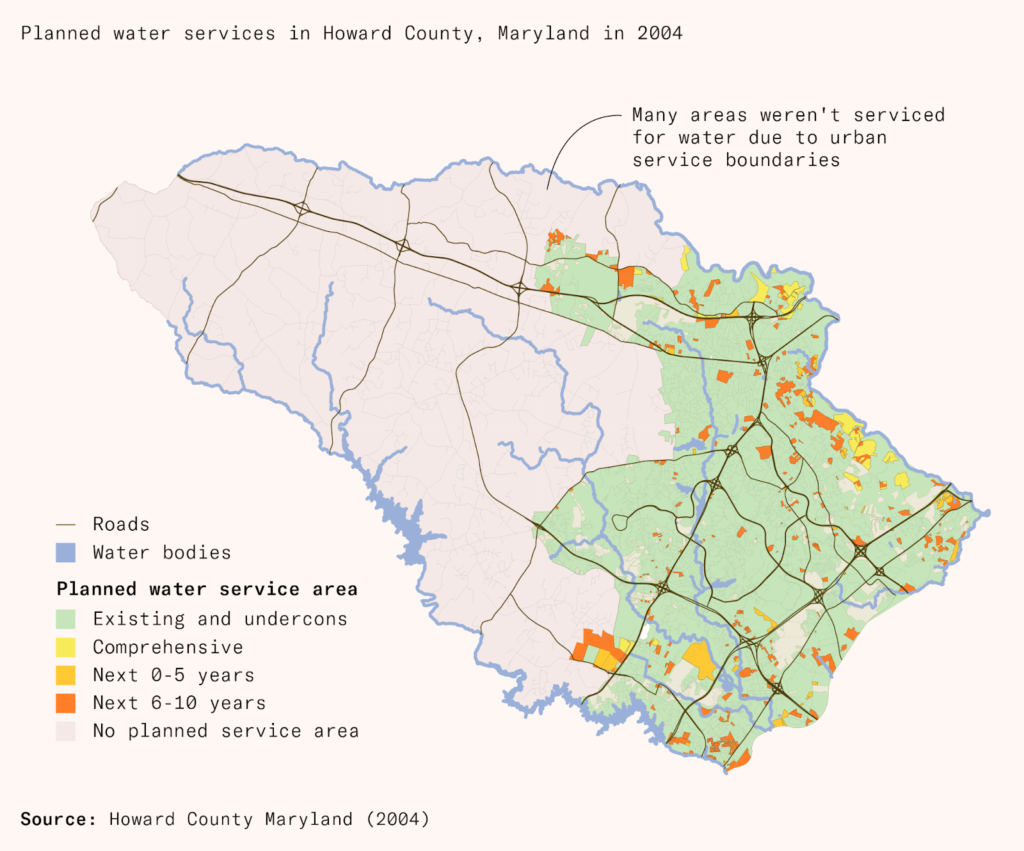
EPA rules mandate certain water quality standards in watersheds, yet such standards are not typically adjusted for population. This means any amount of growth in an area can make it fail the standards, even if blocking growth would just push the population and pollution to other areas. Even inside watersheds, moratoria on hookups often result in lower density and more polluting development attached to well water and septic tanks. (The UK is struggling with a similar issue where a requirement that new developments add literally no nutrient levels in rivers is blocking hundreds of thousands of otherwise-permissioned homes.)
The federal government has come to see part of its environmental mandate as discouraging water use in general. As required by the 1996 Safe Drinking Water Amendments, the EPA issues water conservation ‘guidelines’ that can be incorporated into the mandates for utilities receiving federal assistance. As an EPA official wrote in 2006, ‘Recognizing the need to reduce water use is the first step in developing a strategic plan’ for water utilities.
The federal government has pushed water utilities to use what is known as increasing block pricing, where the first few thousand gallons of water consumed by a household cost the least, the next cost more, and so forth. The goal is conserving water use, since the assumption in many parts of the environmental community is that water is a limited resource that should be kept out of taps as much as possible. Although this rate structure may look like a classic economic way to reduce waste, it poorly reflects the true costs of water systems.
Hooking up and maintaining pipes to a single customer is costly, but a little extra water delivered each month usually isn’t. As one water company president told Congress, ‘the cost structures of utilities are usually inversely related to our revenue structures, and by that I mean that 70 percent of our costs are fixed, but usually 70 percent of the revenues are a risk on consumption. If you have inclining or increasing block rates . . . [that] represents a real threat to the utility recovering the true cost of delivering the water service’. The mismatch between federally encouraged prices and costs has made water systems more reluctant to expand.
Limiting household water consumption is necessary in the short-run during droughts, or in a few truly dry places, but that’s it. The proportion of America’s water use reserved for public drinking water systems is less than 15 percent, even though this kind of water is more valuable than others. The vast majority of the surface water Americans consume serves either irrigation or thermoelectric power, and water for the latter is usually returned directly to streams with minimal effects on downstream users. In the arid West, the proportion used for irrigation is even higher.
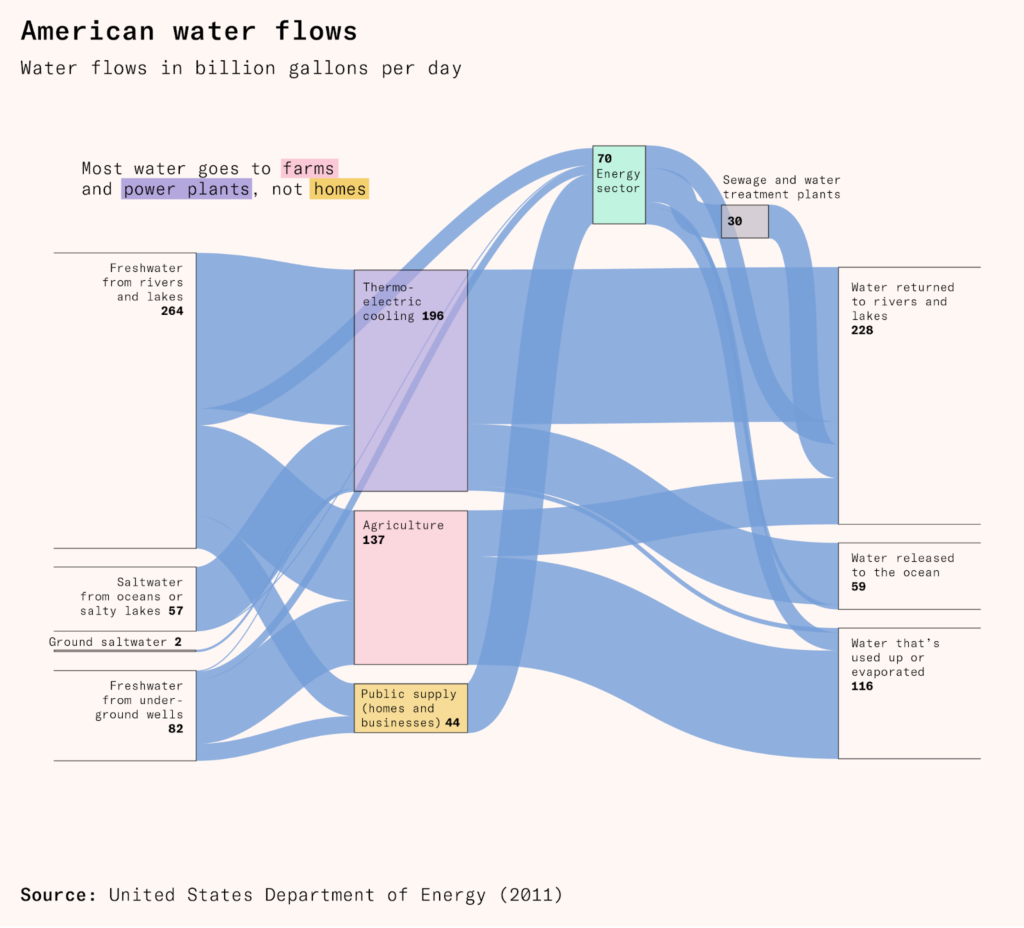
The supposed water wars can largely be solved by redirecting water from low-value irrigation to high-value urban uses. The cost of water is much higher for urban users than irrigators, sometimes by orders of magnitude. But trades are not happening. Right now, because of federal mandates, utility pricing structures, insufficient infrastructure, and a general belief that water is scarce and should therefore be squirreled away and not used, many utilities don’t want more water. Instead they are trying to drive up costs and limit use. As the San Antonio Water System says, ‘it’s important we do everything we can to decrease our water consumption’. Unlike most services or companies, which see their job as meeting consumer demand, utilities see their job as limiting it.
Who should balance costs and benefits?
Drinking water issues are already internalized by local communities. Insofar as there is a case for federal government intervention on surface water, it comes where states’ pollution affect one another. When the federal government intervenes, it could consider looking at cap-and-trade or pricing programs as is commonly done for air pollution, instead of using top-down mandates that, as the EPA says, ‘do not reflect considerations of economic impacts or the technological feasibility’ of meeting them. There are encouraging examples. The states around Chesapeake Bay have a limited cap-and-trade program for the nutrient runoffs that can spread algae and create oxygen-depleted dead-zones.
The federal government can also redirect some of its regulatory focus away from urban areas. The Clean Water Act makes a distinction between ‘point sources’ of pollution, such as from municipal sewage plants and factories, which are tightly regulated and require specific types of technological treatment, and ‘nonpoint sources’, especially the runoff of sediment, fertilizers, and pesticides from farms, which face much vaguer rules. The regulation of point sources means that, according to the EPA, ‘nonpoint source pollution is the leading remaining cause of water quality problems’ today. By one measure, preventing a pound of water pollutants coming from agricultural areas costs less than a tenth of what it costs to prevent it coming out of urban areas. A regulatory system that looked at overall surface water health would find more cost-effective reductions to water pollution.
There is an old joke about a boy who said that he knew how to spell the word ‘banana’ but that he didn’t know when to stop. Officials in control of water today know how to get cleaner water but don’t know when to stop. Local voters already face the problems of balancing costs and benefits and the more distant the regulators, the less likely they are to get the balance right themselves.
America’s water and sewer systems are among the great achievements of its civilization. Today’s high prices are among its failures.