
China is not the world’s largest command economy. It is a continent-sized Silicon Valley.
Imagine if Y Combinator owned and ran San Francisco. Too much traffic? That’s bad for business. Highway 101 would be triple- or quadruple-deckered, and the metropolitan area might have a dozen subway lines, more like Madrid’s or Osaka’s networks than the BART as it stands. Heritage buildings? They’re nice, but this is a tech town. Skyscrapers would fill the entire peninsula. Instead of wealth taxes on billionaires, the city might even cut taxes to encourage more founders and companies to move there.
This is only a slight caricature of how city government works in China. Provincial cities like Hefei and Hangzhou have become world-leading centers of commerce in electric vehicles, consumer electronics, solar panels, batteries, and AI, steered by mayors whose career incentives are similar to those of partners in a venture capital firm, getting promoted if their portfolio grows and fired if it fails. The cities they run function as vertically integrated conglomerates that benefit not just from the success of their local champions, but also from the broader growth generated by masses of companies in their slipstream.
In the West, China’s success is often attributed to the central government’s willingness to pick winners and direct its economy from above. Many Westerners have concluded that a similar top-down approach is needed in their countries to create champions that can compete with China’s. But Beijing’s role is more akin to being a rulemaker in a great tournament. Subnational governments – provinces, cities, towns, villages – are responsible for around 85 percent of public expenditure, according to the IMF, the lion’s share of which is spent at city level.
The heavy state involvement correctly perceived by observers belongs not to Beijing but to those local governments, of which China has thousands, and which compete with one another for investment and prestige. These local growth machines and the competition between them are what drives China’s stunning economic success, and what the Western world must embrace to keep up.
Local heroes
For the initial decades after China’s economic opening in the 1980s, ‘Made in China’ meant cheap goods mass-produced for Western businesses. Today, Chinese companies lead the world in high-tech manufacturing, and many of them are household names in the West. Huawei is arguably the world’s most advanced telecoms company; BYD is the largest electric automaker; and DJI makes over 90 percent of consumer drones. Less familiar but no less important are companies like Geely, an auto giant which began in the 1980s as a refrigerator parts manufacturer and now owns Volvo, Lotus, Polestar and a stake in Aston Martin; and Vivo, now India’s biggest smartphone supplier.
What all have in common is that Beijing played no role in their creation. They were private companies encouraged by local governments. Huawei, BYD, and DJI emerged from Shenzhen’s Special Economic Zone, where municipal bureaucrats could write local regulations without regard for national rules. Geely was quietly supported by Zhejiang province at a time when only state-designated automakers were meant to build cars. Vivo spun off from a company founded in Dongguan, after Zhongshan, the neighboring city, wouldn’t give the company leaders equity.
Some sectors, such as batteries, electronics, and most recently electric vehicles, have received special support from Beijing as strategic industries. Companies in these areas benefited from subsidies, tax rebates, and in the case of electric cars, sales tax exemptions. But though the state was happy to lend its support to certain sectors, it was agnostic as to which specific firms and regions rose to dominance by means of that support. Beijing set a prize, and local bureaucrats competed to win it.
Hefei, the capital of Anhui province in inland Eastern China, is the most famous illustration of this process in action. In 2008, the municipal government invested $500 million in the electronic display company BOE Technology to build a new-generation LCD production line, bringing China to the cutting edge of panel production for the first time. At the time, Hefei was an unremarkable city with no display industry, and BOE was only the world’s ninth-largest manufacturer of LCD displays. The city provided the necessary land, utility connections, and cheap capital (investing almost a tenth of its total revenue that year) to set up a subsidiary company with BOE, in which it had an 81 percent stake. The bet paid off. BOE is now the world’s largest display panel manufacturer and makes about a quarter of smartphone screens worldwide.
The city reinvested the returns from its investment in other venture capital–like bets, which have won big surprisingly often. Hefei’s investment in carmaker NIO, which the city backed in 2020 in exchange for a 24 percent stake, paid off with an internal rate of return exceeding 30 percent. CXMT (Changxin Memory Technologies), 24 percent of which is directly or indirectly owned by the city of Hefei, runs just behind Samsung, SK Hynix, and Micron with 7 percent of the global market for DRAM chips, the short-term memory used in smartphones, PCs, and data centers. Over the decade to 2023, the city had invested roughly $25 billion of public funds, generating reported earnings of nearly $9 billion.
Other cities have followed the venture capital model to bring in similar growth in jobs and tax revenues. The city of Wuhu imported a secondhand Ford engine line from Britain, lured engineers away from state behemoth FAW (First Automotive Works), and copied a Volkswagen design to build a local carmaker. That makeshift venture eventually grew into Chery, today one of the country’s leading carmakers and supplier of Britain’s bestselling car in March 2026, the Jaecoo 7. As well as having seen growth in jobs, exports, and tax revenues, the city of Wuhu retains a 21 percent stake in Chery, worth around $3.7 billion.
Ningde, a relatively modest city in Fujian province in the southeast, is the founding site of CATL, now the world’s biggest battery producer. The city’s leaders made a strategic wager from its founding in 2011, committing land, infrastructure, tax support, administrative coordination, and supplier attraction efforts to help the still-young battery company to scale. CATL’s bases in Ningde now have capacity to produce 330 gigawatt hours of batteries per year – equivalent to almost half the global demand for electric vehicle batteries in 2023.
Growth is the best policy
China’s mayors and provincial governors turn their cities into venture capital portfolios because of the system of incentives in which they operate. Each cadre (the party members and other officials who run the Chinese state) is scored by their superiors in a secret file built up over the course of their career. Prefecture-level party secretaries evaluate county chiefs, who in turn evaluate their juniors heading up townships, who evaluate village leaders, down to the lowest party member.
Promotions – not just for politicians, but across the civil service – are based in large part on scoring the economic performance of the province or city that a cadre is responsible for. For example, the Shaoxing Municipal Party Committee’s 2008 assessment for city leaders featured 100 base points, of which 54 were awarded for economic development, including growth in GDP per capita, local revenue, industrial investment, and exports. Across China in the 2000s, officials who presided over growth 3.3 percentage points higher than their predecessors were 40 to 50 percent more likely to be promoted. Whereas success leads to promotion, failure can mean early retirement, demotion, or disciplinary action.
To further incentivize bureaucrats, promotions are governed by strict, albeit not explicit, age ceilings. A cadre must make the jump from county officialdom to prefecture level by their mid-forties, must take the next jump to provincial or ministerial level by their mid-fifties, and is unlikely ever to reach the Politburo if they have not done so by their sixties. Missing an age window means being locked into a lower tier for the rest of their lives.
What makes these incentives work is the fact that, unlike in many Western systems, provincial governments get to keep much of the money they generate. After 1980, when China’s economy first started to open up, provinces retained roughly 75 of every 100 marginal yuan they raised. Many provincial governments negotiated deals in which they agreed in advance how much income they would owe to Beijing over the next five years or more, meaning that every yuan they subsequently did or didn’t raise went onto their own balance sheet. By 1990, the average marginal retention rate was nearly 90 percent. Local government incentives were sharpened even more after 1994, when a package of reforms cut the share of VAT that provinces and cities kept, leaving them with a hunger for revenue, but often allowed them to keep 100 percent of the upside from state-owned enterprises, and the ability to sell land-use rights, almost all of whose revenues they could keep.
The way these incentives play out is illustrated in the career of Li Qiang, today China’s second most powerful man. Li started at the bottom: he was born in 1959 to an unremarkable family in Rui’an, an ancient but small city in Zhejiang province, and worked factory clerk jobs before joining the local branch of the Communist Party in 1983. Over the following twenty years he pursued a career in local politics, holding a string of provincial posts.
In 2002, he was made party secretary of Wenzhou, a larger city in the same province. Even under communism, Wenzhou had been seen as an outpost of entrepreneurship and private business within Zhejiang. Li’s strategy was to encourage more private companies to start up, bring private capital into infrastructure, and release bottlenecks on land and labor. Wenzhou’s GDP grew 14.8 percent during his first year in charge. After a second year of rapid growth, this time 14.1 percent, he was appointed chief of staff to the provincial party secretary, Xi Jinping.
When Xi took over in Beijing in 2013, Li was promoted to the provincial governorship himself. Li described his strategy as getting the government out of the way to ‘allow the market to play its decisive role, further stimulating the entrepreneurial and innovative drive of the masses’. Zhejiang must replace the ‘restless hand’ of government intervention with the ‘invisible hand’ of market competition, he said. In practice this meant scrapping 8,000 of the province’s legal powers, including over 700 approval requirements.
After success in Zhejiang, Li was put in charge of Jiangsu, before being brought to Shanghai itself. In Shanghai, he once again focused on freeing up private capital. He set up a new stock market, STAR, which became one of China’s main exchanges within a year of launching. He presided over an expansion of Shanghai’s free trade zone. And he announced a raft of reforms to increase the ease of doing business as in Wenzhou, focused on reducing permit requirements.
In 2022, after climbing the ranks for 39 years, Li was elevated to the Party’s top decision-making body, the seven-person Politburo Standing Committee. As the second-ranking committee member, he was now junior only to his former boss, Xi Jinping.
The entire Chinese bureaucracy is staffed this way, from the smallest village to the country’s capital itself. Being a local government bureaucrat is a very different proposition in China than it is in the West. China’s public servants are more like company directors than administrators, making investments to increase their division’s financial performance and improve their professional prospects.
How local governments create clusters
Competition is the driving force of Chinese industrial success. Instead of a single body making decisions for the entire country and passing them down, there are hundreds. When a strategy is proven to work, the country doubles down on it. In this, it is similar to American capitalism, with its hedge funds, investment banks, and venture capitalists, each a competitive central planner, portioning out capital for a sliver of the United States economy.
But China takes it further. In American capitalism, each individual ‘player’ represents their own interests, but nobody represents the interests of the game as a whole, which often makes coordination problems hard to solve. China’s competitive municipal socialism works because of local governments’ role as, effectively, landowners. Because they capture the spillovers of growth through rising land values and tax receipts, local governments create public goods that benefit all the companies in their area.
Local governments in the West have many of the tools that China’s cities have, but they lack the same incentives. Its cities suffer from fragmented political governance, like the San Francisco Bay Area, which is governed by 101 different municipal governments, or from rules that cap or redistribute their property tax revenues. Many Western cities have become dysfunctional even when they host economic clusters that rival those in China.
In contrast, China’s governments retain a large share of the money they raise and are led by cadres whose careers depend on growth. They have both the tools and the incentives to build their economic clusters up as much as they can. Sometimes this means directly luring in anchor firms which attract other companies to the area through tax rebates, specific infrastructure offers, and cheap bank loans.
To bring Tesla to Shanghai, the municipal government under Li Qiang offered $289 million in grants, arranged for $2.2 billion in low-interest loans from Chinese banks, a ten-point cut in the corporate income tax rate from 2019 to 2023, and a 50 percent discount on the 86 hectares of land beneath the factory. The support was so lavish that one Chinese minister reportedly complained that ‘Shanghai leaders were unbelievable – giving away the entire investment without Tesla having to spend a penny.’
Li promised speed along with capital. Elon Musk thought the factory would take two years to build; Li promised to do it in one. Tesla set up a Shanghai-based subsidiary in May 2018, signed a deal with the city in July, contracted for the land it needed in October, began construction in January 2019, and started producing cars in December that year. Even by Musk’s standards, Shanghai’s processes were lightning fast. Retooling an existing factory in Fremont, California, took Tesla almost twice as long, and building a new Berlin gigafactory took almost three times as long. Musk himself credited the Shanghai government as essential for that speed.
Sometimes, as in Hefei, support even means making direct investments that help anchor companies to grow as well as providing equity returns directly to the city’s coffers. Chinese provinces and cities make heavy use of cash subsidies, which total 2 percent of Chinese GDP according to the IMF, compared to around 0.3 percent in the United States and 0.5 percent in the European Union.
These direct inducements and investments are an important part of the puzzle. But these investments would not pay off if cities were not prepared to capitalize on them. Chinese cities are. They zone masses of land for industry, rent it out at a cut price to build the larger cluster around the anchor firms, then fund the discount by selling land to developers who lease it to the workers and entrepreneurs attracted in.
Kunshan, a small city near Shanghai, was a poor place – known as the ‘little sixth’ for being the least developed of the six subdivisions in its region – when, without permission from Beijing, its leaders secretly started an industrial zone in the mid-1980s. Throughout the 1990s and 2000s, Kunshan’s officials courted Taiwanese electronics firms with almost comic enthusiasm, building a Taiwanese school, encouraging Taiwanese restaurants, broadcasting forty Taiwanese TV channels, and offering industrial land at throwaway prices. When Beijing objected to Taiwanese schoolbooks, Kunshan officials lobbied the central government for a compromise and resolved the standoff by blacking out sensitive symbols like the Taiwanese flag.
Nantz and Foxconn were among the first Taiwanese companies to arrive, making boring but foundational parts like electrical connectors and printed circuit boards. Acer Peripherals joined in 1994, opening bases in the nearby city of Suzhou to make keyboards and monitors and bringing 14 major suppliers with it. Thousands of technicians, including Taiwanese expats, circulated between firms in the rapidly growing electronic components industries, forming the largest community of molding technicians in China, and training many more. By the late 2000s, Kunshan made half of all laptops in the world.
This cluster building has been replicated across China, creating cities that concentrate a disproportionate share of global output for specific goods. Zheng’an, in Guizhou province, produces roughly one in seven guitars worldwide. Shaodong, in Hunan, makes 70 percent of the world’s disposable cigarette lighters. Danyang, in Jiangsu, hosts 1,600 companies that manufacture half the world’s spectacle lenses. In a remarkable range of specialized manufacturing sectors, both light and heavy, a Chinese hub holds a world-dominant position.

Almost three quarters of Chinese productivity growth in manufacturing from 1998 to 2007 came from new entrants to the market, rather than the growth of existing businesses. By the end of 2023, China was home to 4.1 million different manufacturing enterprises – almost twenty times as many as the United States – and 96 percent were private, together employing around 105 million people, about eight times as many as the United States.
Clusters allow upstarts to improve products through rapid iteration and low lead times across almost every conceivable industry, and this is the single biggest reason why China is absorbing so many, from simple to advanced. Bambu Lab brought its first 3D printer to market in 22 months and reached $1.5 billion in revenue and 37 percent of the global market for affordable 3D printers within five years. Hesai, a Shanghai-based LiDAR maker, entered the market when the technology was still ultra-expensive, with a robotaxi sensor suite costing more than many entire cars. A decade later, it has become the world’s largest LiDAR supplier, with more than 1.6 million units shipped in 2025 alone. (The most prominent American contender, Luminar, filed for bankruptcy in December 2025.)
The incentive and ability to form economic clusters may be the single most important factor that explains why China’s cities have succeeded over the past three decades while America’s superstar cities have stagnated.
Feeding the growth machines
China’s local growth machines need a tremendous amount of fuel in the form of investment capital. Beijing provides this fuel by generating a giant pile of domestic savings. By preventing ordinary Chinese people from moving more than $50,000 abroad each year and limiting the range of investment opportunities that could be an alternative home for their savings, the government ensures that the country collectively saves an enormous amount of money in domestic banks. Chinese households held 165 trillion yuan ($24 trillion) in bank deposits in September 2025, equal to 122 percent of the country’s GDP.
At the same time, the interest rates that banks pay to depositors are capped, giving banks a huge supply of artificially cheap capital, which they lend out at a small margin. As of early 2025, a typical current-account deposit rate in a Chinese bank is 0.15 percent. Real interest rates, adjusted for consumer inflation, have been negative in almost half of the years since 1999.
The net effect of these policies is an immense forced transfer of wealth from hundreds of millions of savers to Chinese companies. As a result, these firms are highly indebted: corporate debt peaked at 142 percent of GDP in 2016 and is still around 138 percent today. But their financial expenses, including debt interest payments, account for under 1 percent of industrial firms’ turnover. In the United States, by contrast, non-financial corporate debt is roughly half that level, at 72 percent of GDP, but interest payments amounted to about 5.3 percent of sales in 2024.
An unfortunate side effect of this approach is that entrepreneurs may be backed to attempt extremely unlikely, borderline harebrained, schemes. One Chinese carmaker, a spinoff from a real estate developer, was briefly worth more than Ford despite never producing a car. The wider Chinese car industry is enormously overcrowded: the Shanghai-based Gasgoo Automotive Research Institute estimates that the Chinese auto industry had a capacity to build 55.5 million vehicles a year in 2024, but utilized only half of that. Western plants typically utilize 80 percent of their capacity, or above. Even mighty BYD’s profit margin has fallen to a meager 4 percent.
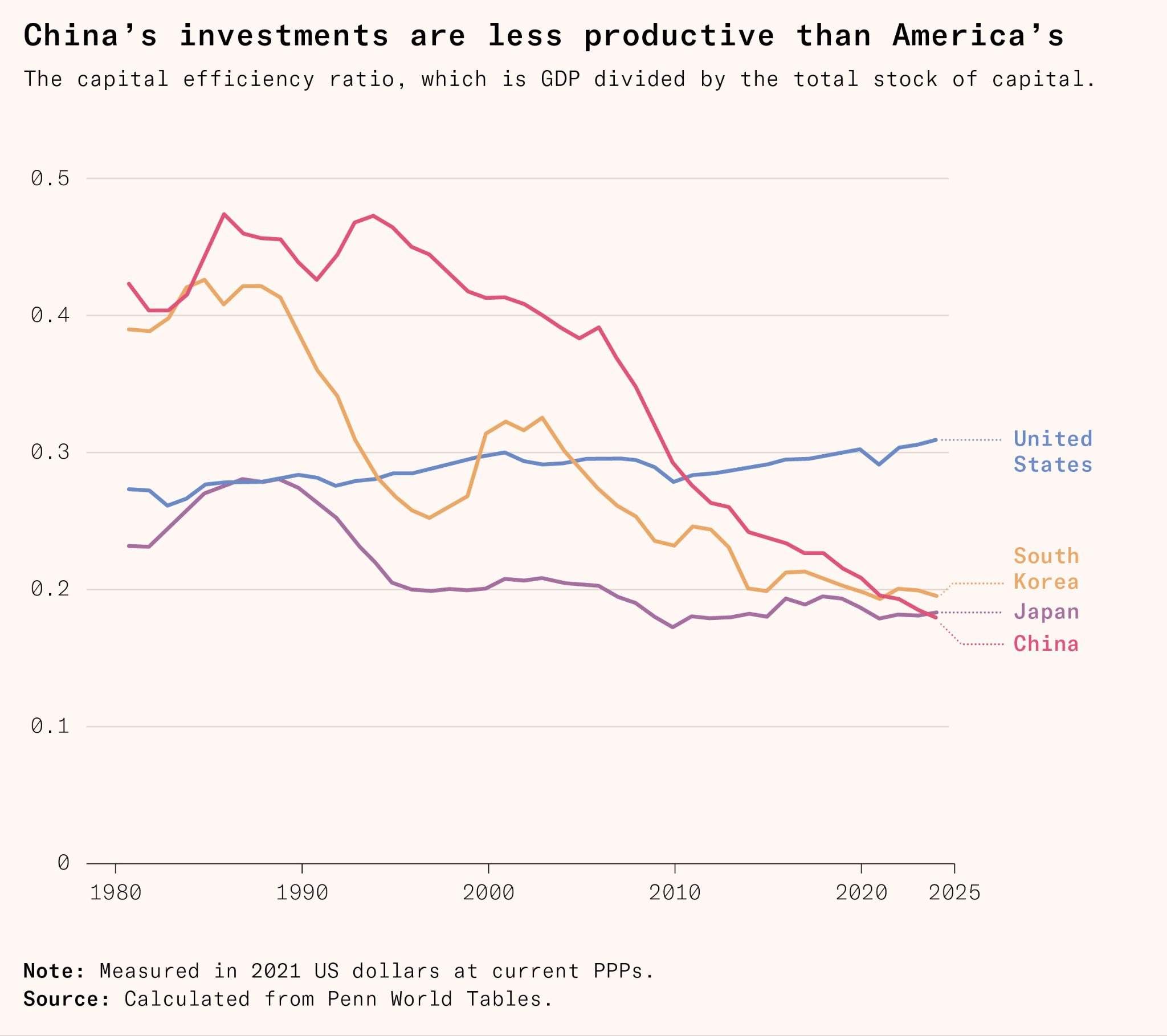
This overexuberance is visible in Chinese macroeconomic data. The capital efficiency ratio measures how much output a country gets out of the capital stock it has invested – how many dollars of GDP a country can buy with a dollar of investment. The United States gets almost twice as much economic output out of every dollar it invests as China does, precisely the opposite of what we would expect from a developed country with a mature economy versus a rapidly growing country playing catch up.
Beijing’s second job, after ensuring the availability of cheap capital, is to rein in the overexuberance it has set off. Local governments piled into steel and coal production in the 2000s and 2010s. After crude steel output surged from 419 million tons in 2006 to 804 million in 2015, the central government launched a drive to cut overproduction, shuttering businesses surviving on debt rollovers, banning net new capacity, enforcing a ban on cheap and dirty induction furnaces, and giving local governments targets to push their excess production down. Coal went through a similar centrally driven cleanup, as did property.
The central government’s third job is policing the tournament and stopping local governments from going too far in pursuit of their own growth at the expense of the wider economy. China’s huge single market would be undermined if provinces or cities put barriers on flows of land, labor, and capital, fragmenting a billion-person market into 34 smaller ones. In the late 2010s, when Beijing began a crackdown on this tendency, some local authorities had been attempting to block goods from entering their borders, or rewritten public procurement specifications to exclude out-of-province bidders.
Such behavior continues to be policed by the Chinese state. On 1st July 2025, Xi Jinping convened the highest-level economic body of the CCP, and devoted it to building a unified national market. His speech framed the task as a precondition for ‘gaining the initiative in international competition’. Energy policy since 2022 has reversed decades of local control: by 2027, most provinces are required to operate a real-time electricity market rather than pre-agreed fixed rates, allowing for more efficient use of energy on a national scale.
Like all powerful incentive systems, the Chinese municipal tournament generates some perverse outcomes. Until 2013, when the scorecard was updated in favor of harder-to-fake measures of activity, the pressure to produce a high GDP figure was so intense that officials routinely fudged the numbers. One study found that mayors still young enough to be promoted reported growth 3.4 percentage points higher than mayors just past the age cutoff, but that this higher measured growth was not reflected by other indicators like lights at night, electricity use, business entry, or productivity.
The power of local officials has sometimes bred corruption: businesses give gifts and favors to officials in exchange for contracts and land deals. But the direction of incentives means that these have largely been payments that greased deals and accelerated projects, rather than negative-sum corruption that simply drains an economy. And like America in the twentieth century, the central government has increasingly cracked down on corruption as China becomes richer and more developed.
The Chicago way
Many Western analysts play up China’s uniqueness. But China today looks a lot like the America of the 1950s and 1960s, when it too was on a rapid upward trajectory powered by local growth machines.
American metropolises of that era were dependent on returns from land development, in their case from the property taxes that supplied 87 percent of local tax income, rather than land sale or leases. Only about a quarter of local government funds were grants from state or (via the state) federal governments, meaning that some 70 percent of revenues were raised locally, implying a high level of local control comparable to China’s today.
America had its own Li Qiangs: Richard J Daley expanded Chicago’s O’Hare Airport to maintain his city’s place as a center of American transportation in the aviation age; Robert Moses and Fiorello LaGuardia bulldozed through historic parts of New York against vigorous opposition to build new roads across New York City; William Hartsfield transformed Atlanta’s airport into the nation’s busiest by 1957, setting the city up to become a center of American logistics and corporate capitalism. These leaders controlled local government bodies like New York’s Triborough Bridge and Tunnel Authority or California’s redevelopment agencies, which were funded by tolls and increased property values. Mayors could capture the spillovers to nearby businesses and reinvest some of them in sanitation, civic amenities, patronage, and more growth, which together won them reelection. They fought for growth because it was in their best interests to do so.
The results were remarkable. America laid 310,000 miles of new local roads between 1950 and 1970, alongside 31,000 miles of new interstate highways. Electricity generation increased sixfold between 1945 and 1975. The number of fully plumbed homes doubled. The share of homes without flushing toilets dropped from 24 to 4 percent. The country’s housing stock doubled from 39 million to 80 million between 1940 and 1975, with the country building three times as many homes per capita in 1972 as it did in 2025.
As in China today, the federal government fed the machines through mortgage insurance, urban renewal subsidies, the Federal Highway Act, and massive defense and research spending. It provided the framework on which American capitalism is based: secure property rights, interventions to stop fraud and corruption, strong capital markets, and a robust defense of interstate commerce.
Similar growth machines powered the city corporation of Manchester, England, when it built a 36-mile canal in the late nineteenth century to turn the inland city into Britain’s third-busiest port, the community of Madrid when it added 126 miles to its metro in 12 years between 1995 and 2007, and Munich when it built its S-Bahn to create a 434-kilometer fast metro network within six years in time to host the 1972 Olympics.
What makes China unique is how widespread these local growth machines still are. Just as in the postwar United States, city leaders are personally incentivized to grow, and city budgets directly benefit when they capture the upside through selling leases or through their stakes in businesses. Like modern-day Fiorello LaGuardias, mayors in China can be overexuberant, but they are rarely timid.
By Western standards, China’s government is interventionist. But this interventionism is directed by a system of competition far more ruthless than in the modern-day United States, let alone Europe. Towns, villages, cities, rural districts, provinces, their leaders themselves, bureaucrats at every position, and yes, millions of private capitalist businesses, compete to win promotion or profits.
There are still some urban growth machines in the West, like Houston and Nashville, that still function the way cities like San Francisco and Chicago once did. But most of its other growth machines have broken down at the very same time that China has built up dozens of new ones. The lesson from China’s economic miracle is not that the West needs a new economic model. It needs its old one.

Subscribe for $100 to receive six beautiful issues per year.